Chinese vs European Used Trucks for Africa 2026 — Actros, MAN and Volvo vs HOWO, Shacman and FAW
Chinese vs European used trucks are usually compared on price alone, and the price gap is real. A used 2019 HOWO 371 dump truck costs $17,000–23,000 FOB Tianjin and about $26,000–32,000 CIF Lagos. For example, a 2015 Mercedes-Benz Actros 2640 tractor, the European truck most African buyers shortlist against it, costs €24,000–37,000 in Europe and lands at $34,000–50,000 CIF. Yet the European unit is older and burns 2–4 litres less fuel per 100 km. Its first turbocharger costs three times as much, and takes three weeks to reach Lagos or Mombasa.
For most buyers that settles the argument. Yet for a few it does not, and those few are usually right about their own business. In our yard in Yuanshi County, Shijiazhuang, we inspect Chinese trucks every week and ship them from Tianjin. When a buyer forwards a European listing and asks us to match it, the first question we ask is not which brand he prefers. Instead, it is how many kilometres a month the truck will run, and who will fix it when it stops.
So this comparison of Chinese vs European used trucks is not a brand loyalty piece. Instead, it sets out what each side actually costs in October 2026. It shows which markets will even accept a 2015 model, and what parts cost on each side of the fence. It also profiles the three buyers where one answer is clearly better. Prices are ranges we see in dealer quotes and move weekly, so treat them as planning numbers rather than offers.
Chinese vs European Used Trucks at a Glance
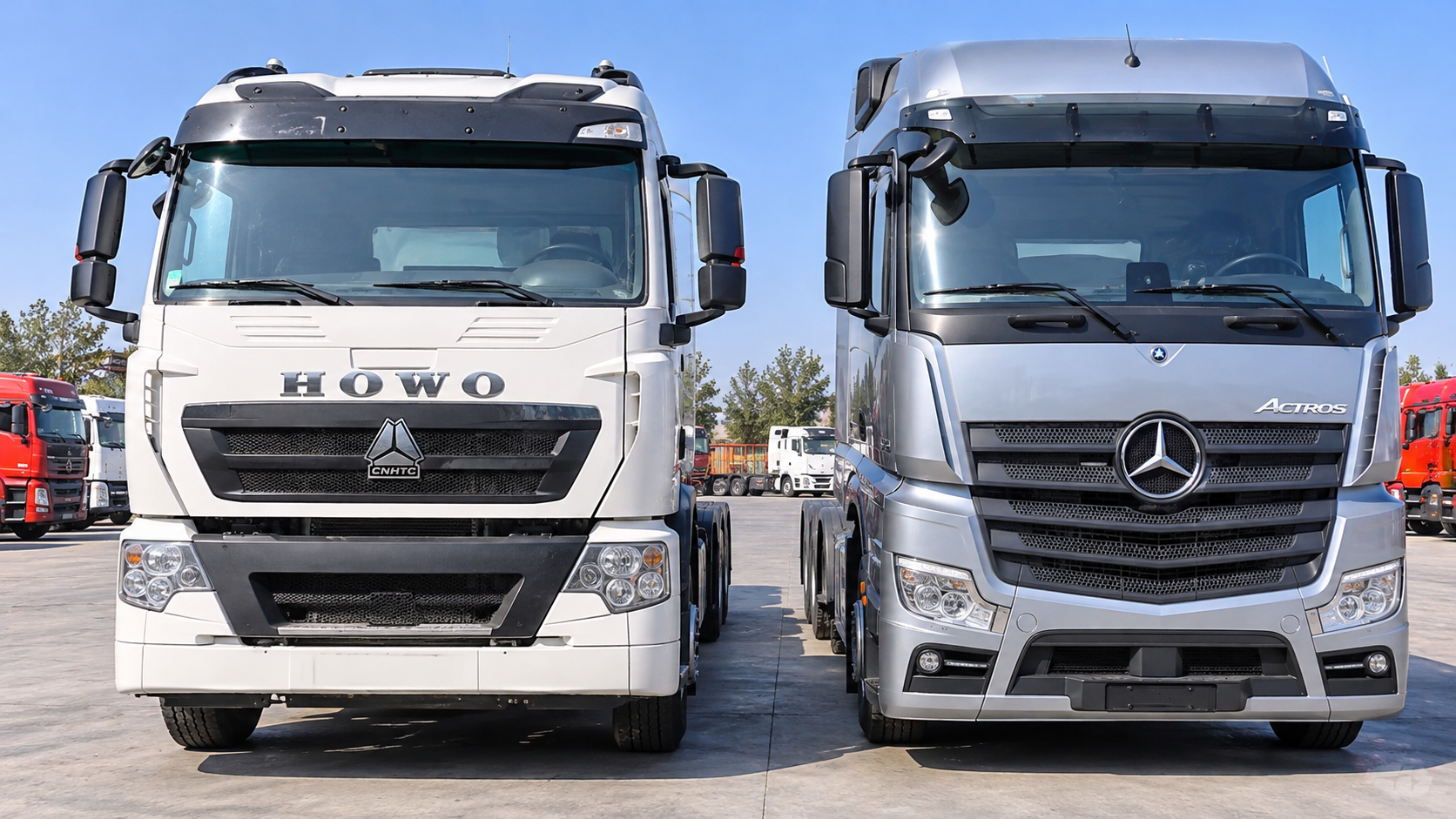
In short, a Chinese truck at any budget is four to six years newer. Its wear parts cost three to five times less, and it resells faster in most African cities. By contrast, a European truck is more comfortable, quieter, better damped, and easier on fuel over long distances. So everything else in this article is detail on those two sentences.
| Question | Chinese used truck (HOWO, Shacman, FAW) | European used truck (Actros, MAN TGS, Volvo FH) |
|---|---|---|
| Model year you get for ~$30,000 CIF Lagos | 2019–2021 | 2013–2016 |
| FOB price, 6×4 tractor | $13,500–21,000 | $24,000–40,000 |
| Ocean transit to Lagos | 25–35 days | 30–40 days |
| Brake pad set, per axle | $35–60 | $160–260 |
| Turbocharger | $380–650 | $1,500–2,600 |
| Fuel at 40 t GCW | 30–36 L/100 km | 27–33 L/100 km |
| Diagnostics | Generic OBD readers work on most systems | Xentry, MAN-cats or Tech Tool needed |
| Time to resell in Lagos | 2–4 weeks | 2–4 months |
| Risk under Kenya’s 2019 rule | Low for 2019+ units | Total — the unit cannot be registered |
Second, two rows in that table deserve a warning. Also, the fuel gap is real, but it is smaller than the purchase gap, and it only pays back at high mileage. Meanwhile, the resale row is the one people ignore until they need cash. In fact, a HOWO sells in a fortnight in Lagos or Kano. By contrast, a 2015 Actros with an electronics fault can sit for a season.
What Chinese vs European Used Trucks Cost in 2026
First, European trucks are not cheaper than Chinese trucks. Instead, they are cheaper per badge, which is a different thing. Indeed, a 2015 Actros 2640 cost roughly €95,000 new. Eleven years later it still asks €24,000–37,000 in Germany, the Netherlands or Belgium. European hauliers keep buying export-grade units, which holds those prices up. Similarly, a 2020 HOWO N7G cost about $45,000 new and now asks $13,500–21,000. Ultimately, age and residual value explain the whole gap.
Chinese vs European used trucks: 2026 FOB to CIF Lagos
| Model (used) | Typical year | Engine | Power | FOB | Ocean freight | CIF Lagos |
|---|---|---|---|---|---|---|
| HOWO 371 6×4 dump | 2019–2021 | WD615.47, 9.7 L | 371 hp | $17,000–23,000 | $3,000–4,500 | $26,000–32,000 |
| HOWO N7G 6×4 tractor | 2019–2021 | MC11.44, 10.5 L | 440 hp | $13,500–21,000 | $3,000–4,500 | $22,000–29,000 |
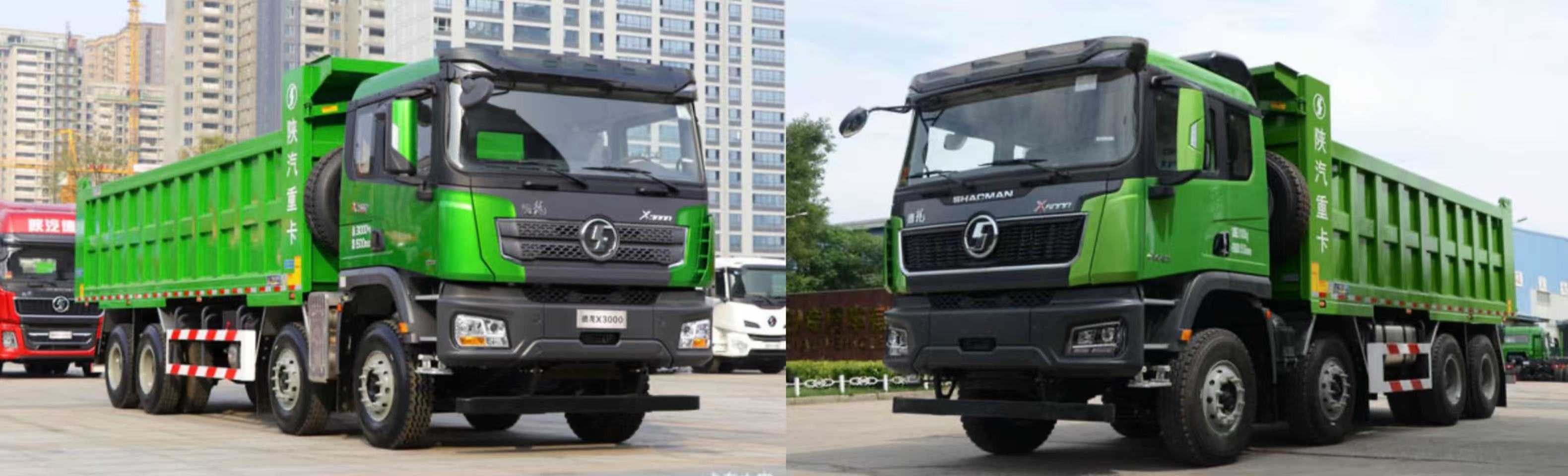
| Shacman X3000 6×4 tractor | 2019–2021 | WP12.430, 12 L | 430 hp | $15,500–21,000 | $3,000–4,500 | $24,000–31,000 |
| FAW J6P 6×4 dump | 2019–2021 | CA6DM2, 11 L | 420 hp | $17,000–23,000 | $3,000–4,500 | $26,000–33,000 |
| Mercedes Actros 2640 6×4 tractor | 2014–2017 | OM470LA, 10.7 L | 400 hp | €24,000–37,000 | $3,500–5,500 | $34,000–50,000 |
| MAN TGS 33.360 6×4 dump | 2014–2017 | D2066, 10.5 L | 360 hp | €26,000–40,000 | $3,500–5,500 | $36,000–52,000 |
| Volvo FH 440 6×4 tractor | 2013–2016 | D13, 12.8 L | 440 hp | €22,000–33,000 | $3,500–5,500 | $32,000–45,000 |
Duty and export preparation
Still, those CIF figures exclude duty. In Nigeria the effective charge is about 37% of CIF value. So a $40,000 Actros becomes roughly $55,000 at the port, before a clearing agent lifts a finger. By comparison, a $27,000 HOWO becomes roughly $37,000. Meanwhile, our full landed-cost breakdown walks through the whole stack, and the tractor truck price guide keeps the Chinese side current.
Meanwhile, the euro figures are converted at about $1.08, which is where it has sat through most of 2026. If you are comparing a listing on a European portal, add the export preparation too. Budget for new tyres if the originals fail inspection, a service, plus export plates or a T1 document. That works out at $2,500–4,000 on a European unit and $600–1,200 on a Chinese one, because Chinese export yards already prepare trucks to that standard.
Before you argue about horsepower, check the model sheets. For instance, the Actros technical sheet lists the 2640 6×4 at 400 hp. The MAN TGS range runs from 320 to 640 hp across the same cab. Yet neither sheet tells you what the truck will cost to keep alive in Kumasi.
Why a €30,000 Actros Lands at $45,000 in Lagos
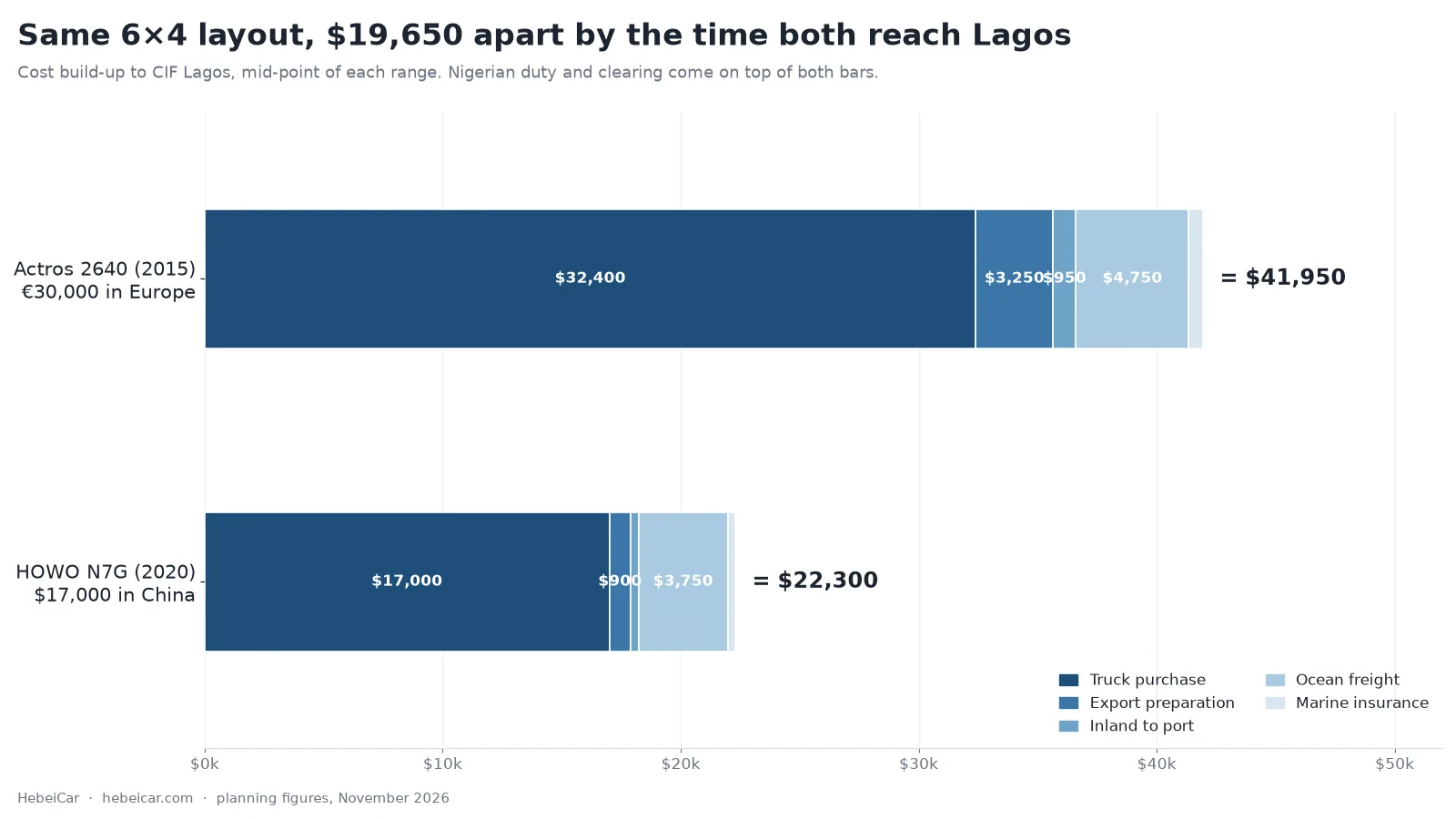
Because the sticker price is the smallest part of the story. To start with, freight from Antwerp, Bremerhaven or Rotterdam is $1,000–1,500 higher than from Tianjin. European dealers also charge for export preparation that Chinese yards include. Insurance, meanwhile, is calculated on a higher declared value. All in all, a €30,000 truck reaches Lagos at around $40,000 CIF, then $55,000 after Nigerian duty.
| Cost line | Actros 2640 (2015) | HOWO N7G (2020) |
|---|---|---|
| Purchase price | €30,000 (~$32,400) | $17,000 |
| Export preparation (tyres, service, documents) | $2,500–4,000 | $600–1,200 |
| Inland transport to port | $700–1,200 | $250–400 |
| Ocean freight to Lagos | $4,000–5,500 | $3,000–4,500 |
| Marine insurance (about 1.5%) | $550–650 | $300–350 |
| CIF Lagos | ~$40,000–43,500 | ~$21,000–23,500 |
| Duty and levies (about 37% of CIF) | $14,800–16,100 | $7,800–8,700 |
| Clearing agent, port charges, delivery | $2,500–4,000 | $2,000–3,000 |
| On the road in Lagos | ~$57,000–63,000 | ~$31,000–35,000 |
That is a $22,000–28,000 gap for two trucks that will pull the same trailer. However, the gap is not the whole argument either. The European truck will still be working when the Chinese one has had an engine overhaul. That holds only if it is maintained with the right parts and diagnostic equipment, and that condition breaks most deals.
Age Limits Rule Out Most European Trucks Before Price Matters
In East Africa the decision is made for you. Because Kenya requires right-hand drive and first registration in 2019 or later, a 2015 Actros cannot be registered at all, whatever it costs. Meanwhile, Tanzania allows older units but slaps an excise penalty on anything past eight years, which a 2015 model pays and a 2020 HOWO does not. By comparison, Ghana gives you until 15 years, which means a 2015 Actros still clears today and will not in 2030.
| Market | 2026 rule | 2015 Actros | 2020 HOWO |
|---|---|---|---|
| Nigeria | 12-year guideline, applied at the terminal; heavy trucks usually clear if documents are clean | Borderline — get written confirmation before paying | Yes |
| Kenya | Right-hand drive, first registered 2019 or later | No | Yes, if RHD |
| Ghana | 15 years maximum, Certificate of Conformity before loading | Yes, at 11 years | Yes |
| Tanzania | Excise penalty above 8 years | Yes, with penalty | Yes, no penalty |
| Zambia | No age limit for trucks | Yes | Yes |
| DRC | Trucks 15 years; mining and forestry tractors 20 | Yes | Yes |
| South Africa | Used commercial imports effectively restricted (ITAC permit) | No | No |
Before you read any spec sheet, read that table. In short, a European truck legal in Lagos and Tema may be scrap in Mombasa. The same unit that works in Lusaka cannot be sold on to a Kenyan buyer later. If you want the full rules, our country-by-country age limit guide covers them, including the inspection regimes that sit behind them.
Parts: Where Chinese vs European Used Trucks Really Differ
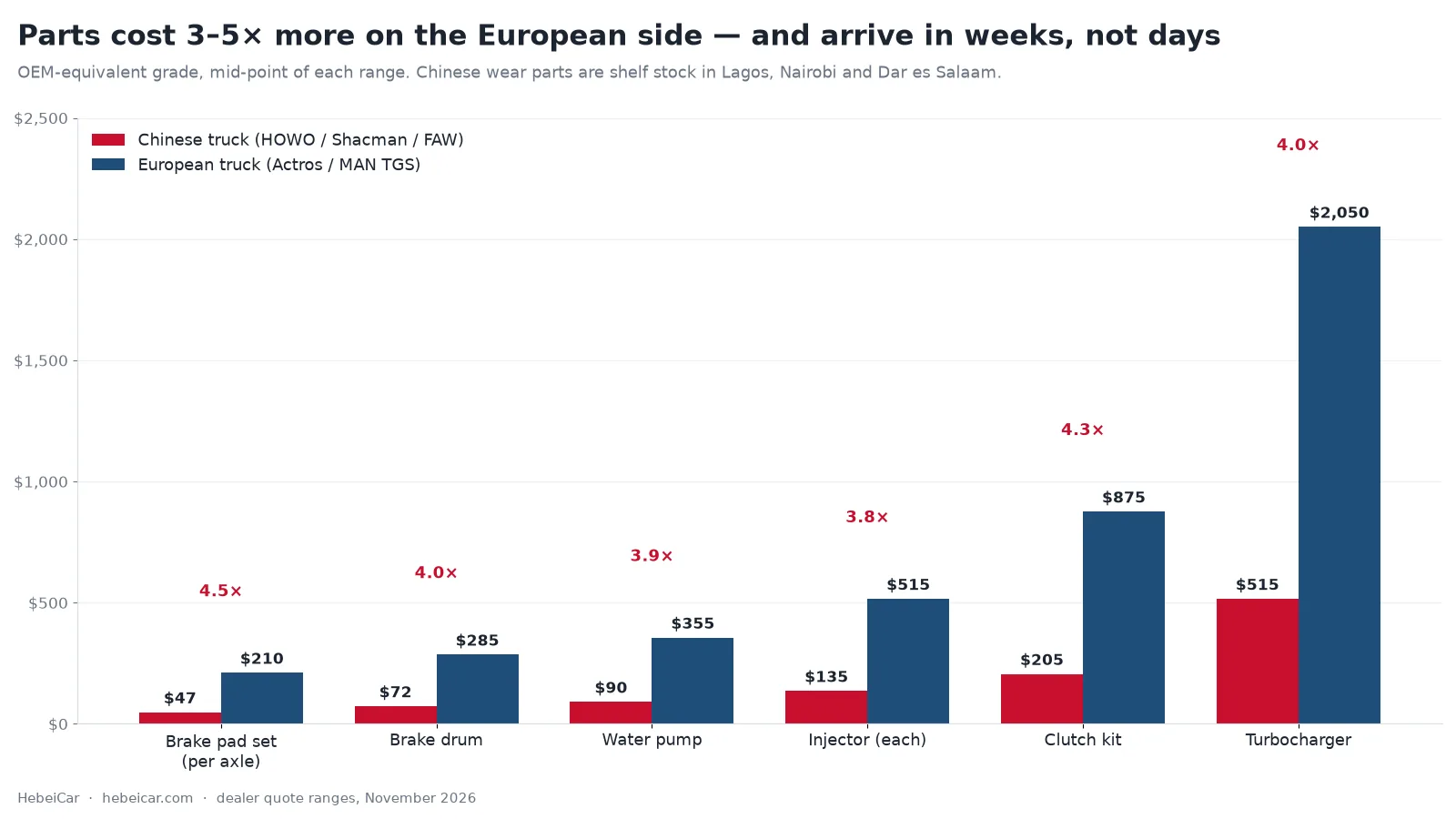
For Chinese vs European used trucks, parts decide more purchases in Africa than fuel, comfort or badge. For example, a HOWO brake pad set is on a shelf in Apapa, Kano, Nairobi or Dar es Salaam today. By contrast, an Actros pad set is usually a special order, and the price difference is not 20% — it is three to five times, part for part.
| Part (OEM-equivalent grade) | Chinese truck | European truck | Lead time in Lagos |
|---|---|---|---|
| Brake pad set, per axle | $35–60 | $160–260 | Same day (China) vs 2–4 weeks (Europe) |
| Brake drum | $55–90 | $220–350 | 1–3 days (China) vs 2–4 weeks (Europe) |
| Clutch kit | $150–260 | $650–1,100 | 1–3 days (China) vs 3–5 weeks (Europe) |
| Turbocharger | $380–650 | $1,500–2,600 | 3–7 days (China) vs 3–6 weeks (Europe) |
| Injector, each | $90–180 | $380–650 | 1–3 days (China) vs 3–6 weeks (Europe) |
| Water pump | $60–120 | $260–450 | 1–3 days (China) vs 2–4 weeks (Europe) |
| Air filter | $12–30 | $60–110 | Same day (China) vs 1–2 weeks (Europe) |
| Headlamp assembly | $25–45 | $150–320 | 1–3 days (China) vs 2–4 weeks (Europe) |
| Windscreen | $80–150 | $400–800 | 3–7 days (China) vs 2–5 weeks (Europe) |
Similarly, those are aftermarket OEM-equivalent prices, which is what most African workshops fit. Meanwhile, genuine factory parts run 1.5–2× higher on the Chinese side and up to 2.5× on the European side. Also, our Chinese truck spare parts guide explains how to tell a good aftermarket part from a bad one. The spare parts service page covers what we can ship with a truck.
Diagnostics and Diesel: The Hidden Cost
Then comes the part nobody puts in a brochure: diagnostics. First, a Euro 5 or Euro 6 Actros, MAN TGS or Volvo FH is a multiplexed truck. So reading its fault codes needs Xentry, MAN-cats or Tech Tool, plus a laptop that a workshop in Kumasi or Mbeya probably does not own. By contrast, Chinese trucks built on WD615, WP10/WP12 and CA6DM2 engines still use largely generic sensors and Bosch or Delphi injection components. So a competent mechanic with a generic reader can usually get you moving. In practice, that difference is worth more than the fuel saving where the nearest dealer is 600 km away, and it is the point where Chinese vs European used trucks stop being a price argument and become an uptime argument. It is also where Chinese vs European used trucks separate most sharply.
Then there is the other quiet killer: diesel quality. Although European emission systems are calibrated for EN 590 fuel at 10 ppm sulfur, many African markets still sell diesel well above that. Poisoned SCR catalysts and blocked DPFs then turn into a derate, and a derate turns into a tow. Yet some importers simply delete the system, which is illegal in most markets and ruins resale. For this reason, Chinese trucks sold for export generally carry simpler Euro 2–Euro 3 equivalent calibration. If you want the longer version, our engine comparison covers fuel tolerance and rebuild costs.
Chinese vs European Used Trucks: Fuel and Cost per Kilometre
Yes, the European truck uses less fuel. Specifically, a 2015 Actros 2640 at 40 t gross runs 28–33 L/100 km loaded; a 2020 HOWO N7G 440 runs 30–36 L, which is the whole reason Chinese vs European used trucks get compared on fuel at all. On fuel alone, Chinese vs European used trucks are closer than most sellers claim. The gap is 2–4 litres per 100 km, or roughly $3,000–4,500 a year at 8,000 km a month. That is on Nigerian diesel at $1.29 a litre. However, it is a real saving, and it is smaller than the purchase gap.
| Truck | Loaded | Empty | Fuel cost per month* | Fuel cost per year* | Maintenance reserve per km |
|---|---|---|---|---|---|
| Mercedes Actros 2640 | 28–33 L | 17–20 L | $2,890–3,410 | $34,700–40,900 | $0.06–0.10 |
| Volvo FH 440 | 27–32 L | 16–19 L | $2,790–3,300 | $33,500–39,600 | $0.06–0.10 |
| HOWO N7G 440 | 30–36 L | 18–22 L | $3,100–3,720 | $37,200–44,600 | $0.03–0.05 |
| HOWO 371 dump | 32–38 L | 13–16 L | $3,300–3,920 | $39,600–47,000 | $0.03–0.05 |
*8,000 km a month, diesel at $1.29/L (Nigeria, October 2026, GlobalPetrolPrices). Multiply by 1.30 for Kenya at $1.67/L.
Now put the maintenance reserve next to it. In fact, the European truck saves roughly $3,000–4,500 a year in fuel and spends roughly $2,900–4,800 more on parts and specialist labour at 96,000 km a year. In effect, the two numbers cancel in year one. Yet the $22,000–28,000 purchase gap does not. As a result, European trucks only pay back for operators who run them past 1.2 million km with a workshop that knows them. Our fuel consumption study has the per-kilometre maths for both sides, country by country.
How Long Chinese vs European Used Trucks Last — and What They Resell For
First, an Actros or FH is built for 1.5–2 million km. By contrast, a HOWO 371 or Shacman F3000 usually needs its first major engine work between 500,000 and 800,000 km, with good examples reaching 900,000. Those numbers are honest, and they are also conditional: the European figure assumes genuine filters, the right oil, working AdBlue and a workshop with the right laptop. Yet strip those away and a 900,000 km Actros with a tired injector set is a $6,000 repair waiting to happen.
Then there is resale, the other half of ownership cost. In practice, Chinese trucks are liquid in Lagos, Kano, Accra, Nairobi and Dar es Salaam. A clean 2020 HOWO 371 sells in two to four weeks at 55–65% of what it cost landed. Meanwhile, European trucks hold a higher absolute value but sell to a much thinner buyer pool, and an electronics fault can double the selling time. If your exit plan is to sell the fleet in three years, that liquidity matters more than the badge. Our resale value guide and the lifespan guide go deeper on both.
Chinese vs European Used Trucks: When Europe Wins
Buy European when the truck runs long distances, carries high-value cargo, and sleeps in a yard with a workshop. For example, consider a Lagos–Onitsha or Lagos–Kano haulier running 12,000–18,000 km a month with its own mechanics and a parts account. The same logic covers a cement or LNG contractor whose downtime penalty exceeds the parts premium. It also covers a Kenyan or South African fleet that needs right-hand drive and dealer support within 100 km. In those settings the fuel saving, driver comfort and 1.5 million km design life all compound in your favour.
Moreover, comfort is not a soft benefit either. Indeed, on a 900 km corridor, a quiet cab with air suspension seats keeps drivers. Fleets that struggle to retain drivers often find the European premium pays for itself in retention and accident rates before it pays in fuel. If that is your situation, the Chinese vs Japanese comparison is worth reading too, because Japanese trucks sit between the two on price and parts.
Chinese vs European Used Trucks: When China Wins
Buy Chinese for tippers, mining haulage, first trucks, growing fleets and any market with a 2019-or-later rule. Because a construction or quarry operation does 40,000–70,000 km a year at low speed, a European truck’s long-haul advantages never show up. Its electronics also suffer from dust and heat. Moreover, a Chinese tipper costs half as much landed, its parts are in the next town, and a bush mechanic can keep it running.
Also, it is the only practical answer in right-hand-drive East Africa, where 2019+ units are mandatory and European RHD stock at that age is scarce and expensive. If you are a dealer buying three to ten units, the fleet order guide covers consolidation and mixed loading. And if you are still choosing a brand inside the Chinese camp, the HOWO vs Shacman vs FAW comparison is the place to start.
Frequently Asked Questions
Is a used Actros better than a used HOWO?
Only for long-haul work with workshop support. An Actros is quieter, burns 2–4 L/100 km less and lasts longer. However, it costs $22,000–28,000 more landed, parts are 3–5× dearer, and a 2015 unit is illegal in Kenya. So tippers should stay with HOWO.
Why is a 2015 Actros more expensive than a 2020 HOWO?
Because it cost roughly €95,000 new against $45,000, and European residuals stay high while Chinese exports fall faster. You are buying a pricier truck five years older, and age decides which markets register it.
Can I import a 2015 Actros into Kenya?
No. Kenya requires right-hand drive and first registration in 2019 or later, so a 2015 Actros cannot be registered, even with a clean inspection. Instead, the same money buys a 2020 RHD HOWO or Shacman. However, Tanzania and Zambia still accept older units.
Are Mercedes-Benz truck parts available in Nigeria?
Wear items, yes: pads, filters and drums for Actros 2640/2646 are stocked in Lagos and Port Harcourt. Electronics, injectors and SCR parts are a 2–4 week order. In short, that wait, not the price, stops most European trucks.
Which is cheaper per kilometre, Chinese or European?
A Chinese truck is cheaper by $0.03–0.06 per km before finance, including parts and labour. The European closes that gap above 12,000 km a month, and beats it only past 1.2 million km with in-house maintenance.
Will a Euro 6 Actros run on African diesel?
It will run, but the SCR and DPF are calibrated for 10 ppm sulfur fuel, and higher-sulfur diesel shortens catalyst life and can trigger a derate. Then ask what fuel the truck will see, and budget for AdBlue.
Three Buyers, Three Answers ($30,000 Budget)
Abstract comparisons are useless without a use case. Instead, here are the three we see most often, and what we would put on the water.
- First-time tipper owner, Nigeria, $30,000. A 2020 HOWO 371 6×4 dump at about $27,000 CIF Lagos plus clearing. Parts in every market, resale in weeks, and the truck fits sand, gravel and construction work. Do not stretch to an Actros at this budget — you would be buying a 2013 unit with no repair reserve.
- Established haulier, 14 trucks, Lagos–Kano, $30,000 per unit. Two 2015–2016 Actros 2646 units at $38,000–45,000 CIF each, if you have a workshop and a parts account. Otherwise one new HOWO N7G and keep $10,000 as a repair fund. Instead, the answer depends on your maintenance capability, not your ambition.
- Copperbelt contractor, Zambia, $30,000. A 2020 HOWO 380 8×4 or Shacman F3000 8×4 at $28,000–33,000 CIF Dar es Salaam plus road freight. Zambia has no age limit, but the extra axle and 31 t GVW matter more than badge on mine haul roads.
Ultimately, the same rule applies in all three cases: match the truck to the roads, the load and the mechanic you actually have. Never match it to the brochure you wish you could afford.
How to Inspect Either Truck Before You Pay
Inspection is where Chinese vs European used trucks converge, because the failures look the same. Check these eight things on any European or Chinese unit before money moves.
- Year plate and VIN. Confirm the model year on the chassis plate matches the documents, not the advert. On European units, check the first-registration date as well, because that is what customs and Kenya’s NTSA read.
- Odometer against wear. Indeed, pedal rubber, seat bolsters, steering wheel and gear knob tell you more than the clock. Then again, a 1.1 million km Actros can be honest; a 300,000 km one with a worn-out cab is not.
- Cold start and blow-by. Then watch it start from cold and open the oil filler cap. In that case, heavy breathing means rings or liners.
- AdBlue and SCR history on any Euro 5 or Euro 6 unit. Also look for deleted systems, emulators and warning lights that never come on.
Frame, driveline and paperwork
- Frame and crossmembers. In particular, cracks near the spring hangers are common on African roads and expensive to fix properly.
- Gearbox and retarder. Then road-test under load. Even so, a slipping retarder on a European unit is a $3,000–5,000 surprise.
- Brake and tyre condition. Also, sixteen tyres on an 8×4 is a $4,000–6,000 line item if they are finished.
- Service records and fault codes. Then ask for a diagnostic printout. Regardless, a seller who cannot produce one is telling you something.
So we run a 30-point check on every unit, with photos and video of the actual truck. The list is in our inspection checklist, and the VIN and accident history guide shows how to verify a unit before it ships. If a seller refuses a cold start or a diagnostic scan, walk away — the scam guide explains why.

Quick Answer — Chinese vs European Used Trucks for Africa
- A 2020 HOWO 371 dump lands at $26,000–32,000 CIF Lagos; a 2015 Actros 2640 lands at $34,000–50,000 and roughly $55,000 after Nigerian duty.
- Yet European trucks use 2–4 L/100 km less fuel, worth $3,000–4,500 a year at 8,000 km a month — about the same as their extra maintenance cost.
- European parts cost 3–5× more and arrive in 2–4 weeks; Chinese parts are on the shelf the same day in most African cities.
- Consequently, Kenya bans anything first registered before 2019, which removes every 2015 Actros from the market regardless of condition.
- Overall, buy Chinese for tippers, mining, first trucks and RHD East Africa; buy European for long-haul fleets with their own workshop and a parts account.
If you want a straight answer for your own route and budget, message +86 157 1768 7720 on WhatsApp with the word COMPARE. Include your country, load, monthly mileage and the model you are considering. Then we will reply with real stock, a 30-point inspection report and a firm CIF price, including the option you probably should not buy. You can also start from used tractor trucks, dump truck buying guide, or the import guides by country.
About the Author
Bean Wang is the founder of HebeiCar, the trading name of Ziquan (Xingtai) International Trade Co., Ltd. The company exports used trucks from Yuanshi County, Shijiazhuang, Hebei, China. Since 2014 he has helped more than 500 fleet owners and dealers across 20+ African countries source inspected HOWO, Shacman, FAW and FOTON trucks at factory-direct prices. In short, the comparison above comes from yard inspections and from owners reporting what their trucks cost to run after delivery, not from manufacturer brochures.
Related reading: Chinese vs Japanese trucks, China vs Dubai sourcing, full landed-cost breakdown, warranty and after-sales, and the prime mover buyer’s guide.