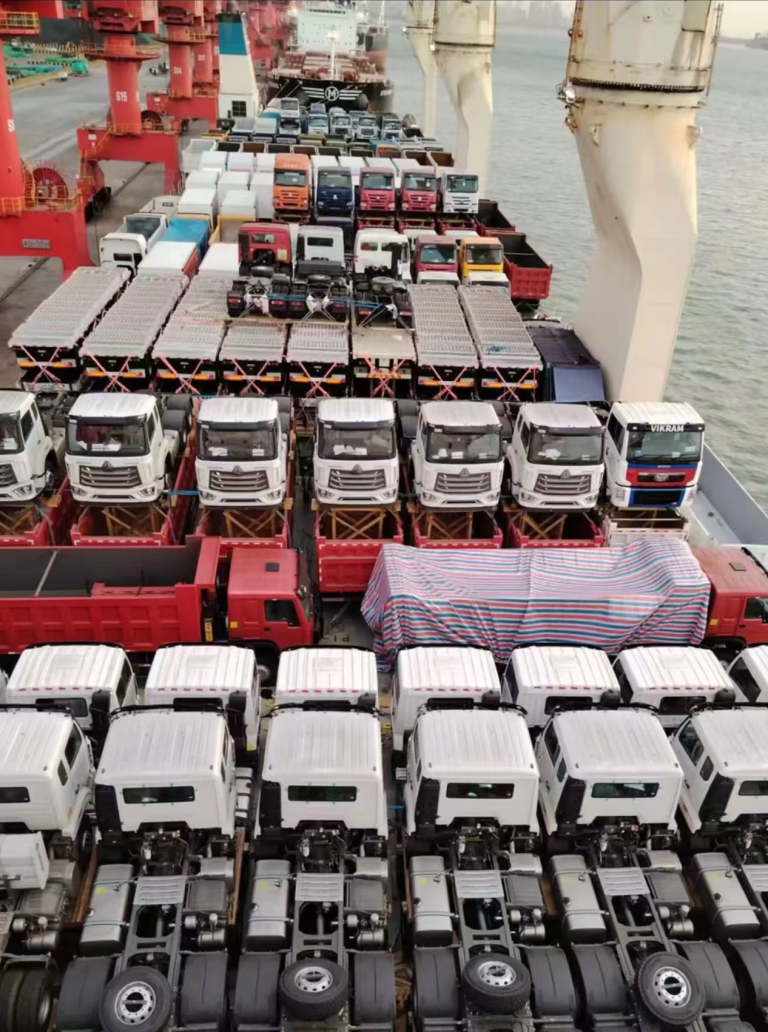

Used Trucks from China vs Dubai for Africa (2026): Real Prices, RHD Stock and the Costs Nobody Quotes
On a like-for-like basis, used trucks from China vs Dubai differ by $3,000–6,000 per unit, and China is almost always the cheaper side. For a Chinese-brand truck, buying at the source costs less than buying the same year and model out of a Dubai yard. For a Japanese right-hand-drive truck — Hino, Isuzu, Fuso — China is not an option at all, and the honest comparison becomes Japan-direct versus a Dubai reseller.
That is the short version. In reality, the gap between used trucks from China vs Dubai is not the same in Lagos as it is in Mombasa, and it is not the same for one truck as it is for eight.
Of course, we export from Tianjin, and our yard sits in Yuanshi County, Shijiazhuang. So yes, we have a horse in this race, and you should read the rest of this page with that in mind. Because of that, the Dubai numbers below are mostly the quotes buyers forward to us and ask us to match — not our own price list dressed up as market research.
Used Trucks from China vs Dubai: The 60-Second Answer
First, Dubai is not a manufacturer and not a source market. Instead, it is a warehouse with excellent port access. Basically, Jebel Ali handles goods that enter a free zone without duty, sit there until a buyer appears, and leave again on an export declaration — a system the free zone operators describe openly (JAFZA), and one Dubai Customs administers through Mirsal 2 (Dubai Customs). In short, that model is brilliant for speed and for small lots. But it is not brilliant for price.
| What you are buying | China (Tianjin / Shanghai) | Dubai (Jebel Ali) |
|---|---|---|
| Chinese brand, LHD market — Nigeria, Ghana, DRC, Senegal | ✅ 10–25% cheaper, stock at source | ❌ You pay a warehousing and trading layer |
| Chinese brand, RHD market — Kenya, Tanzania, Zambia | ✅ Factory RHD or a documented conversion | ⚠️ Often a converted unit with no conversion record |
| Japanese brand, RHD market | ❌ China does not build Hino, Isuzu or Fuso | ✅ Genuine stock, 10–15 days to Mombasa |
| One truck, cash, needed in three weeks | ⚠️ 6–8 weeks door to port | ✅ Usually the fastest route |
| Five trucks or more, one spec | ✅ Best price, one inspection standard | ❌ The margin multiplies by five |
If your answer is “Chinese truck, five units, Lagos”, stop reading and go straight to the landed-cost breakdown. If your answer is “Japanese RHD, one unit, Mombasa”, Dubai or Japan-direct is genuinely the better road, and I will say so again further down.
Why Buyers Ask About Used Trucks from China vs Dubai
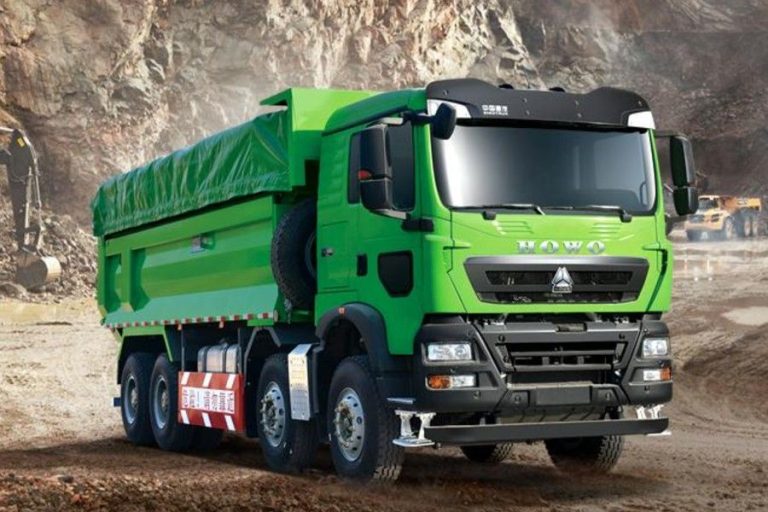
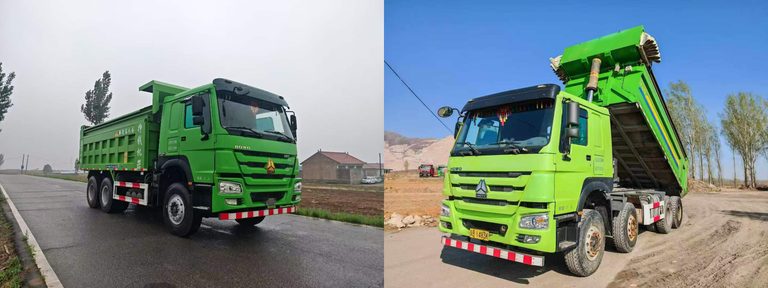
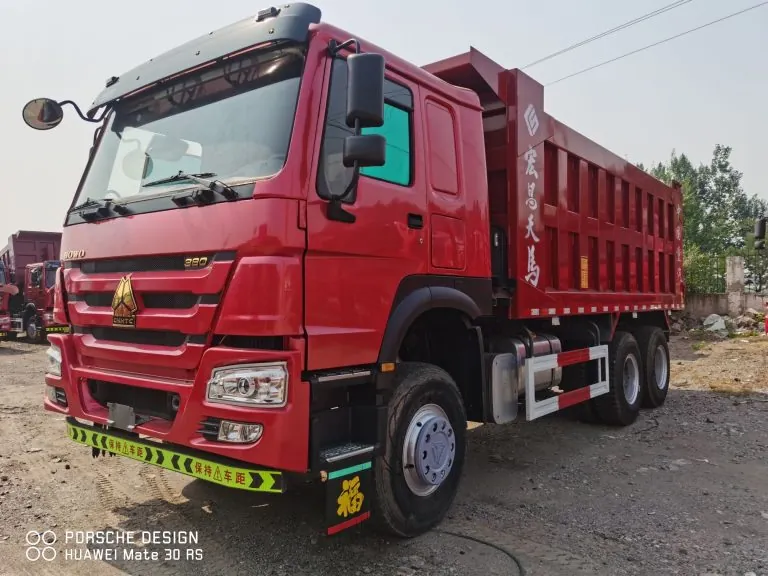
Because the listings look identical. A 2019 HOWO 371 tipper photographed in a dusty yard is a 2019 HOWO 371 tipper, whether the yard is in Shijiazhuang or in Al Aweer. In fact, the photos are often the same photos, passed down the chain.
Last month a dealer in Kumasi sent us four Dubai quotations for the same truck we had quoted him. In fact, two of them were cheaper than ours on paper. However, both turned out to be ex-yard prices at Jebel Ali with freight, insurance and destination charges quoted separately — the numbers only looked lower because half the cost was missing. Then there was the third: a 2018 unit advertised as a 2019. Finally, the fourth was a real 2019, and it was $4,200 above our FOB for the same spec.
To be sure, Dubai traders are not villains; they are businesses that carry stock, pay rent and take a margin. So the question is whether you need to pay for that service.
Who You Are Actually Buying From
In China, you are usually buying from an exporter who bought the truck from a domestic fleet, a leasing company or a trade-in pool. We see the truck before it is cleaned, which is the only time you can tell a leaking rear main seal from a fresh pressure wash. Meanwhile, the chain of custody is one step: fleet to exporter to you.
In Dubai, you are buying from a trader who may have bought the unit from another trader. A used Chinese truck in a Dubai yard has usually been to China already — bought at Tianjin, shipped to Jebel Ali, cleared into a free zone, and re-listed. Likewise, a used Japanese truck has been to Japan first. Either way, by the time it reaches you it has been photographed, priced and handled at least twice.
Still, none of that makes the truck bad. But it does mean the paperwork you receive describes the previous export, not the original registration, and that the seller’s knowledge of the machine is limited to what the last seller told him.
Price: What Used Trucks from China vs Dubai Actually Cost
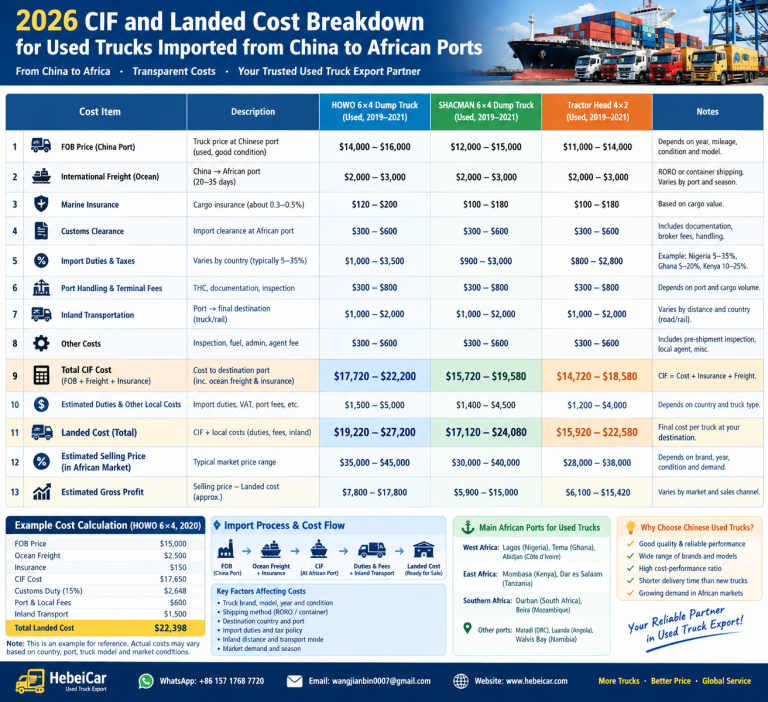
The table below is indicative for October 2026. The China column is our own trading range; the Dubai column is what buyers have forwarded to us in the last quarter, converted to USD and stripped of freight so the two are comparable.
| Unit (used, export-ready) | FOB China | Dubai yard price, ex-works | Gap |
|---|---|---|---|
| HOWO 371 6×4 dump, 2019 | $14,500–16,000 | $17,000–21,000 | +$2,500–5,000 |
| HOWO 371 6×4 dump, 2021 | $19,000–23,000 | $22,000–27,000 | +$3,000–4,000 |
| Shacman F3000 6×4 tractor, 2020 | $12,500–15,500 | $15,000–19,000 | +$2,500–3,500 |
| HOWO 8×4 dump, 2020 | $22,000–28,000 | $26,000–33,000 | +$4,000–5,000 |
| Japanese RHD tractor, 2016–2019 | Not available | $18,000–35,000 | — |
Actually, two things drive the gap. First, the trader’s margin, typically 8–20% depending on how long the unit has sat. Second, double handling: unloading at Jebel Ali, storage at roughly $15–40 per unit per day, reloading, and a second set of documentation. On a $16,000 truck, that is $2,500–5,000 of cost that did not exist in Tianjin.
Then comes the part almost nobody quotes you: duty compounding. Customs charges duty and VAT on the CIF value at your port. As a result, a truck bought through Dubai carries a higher CIF, so the tax bill rises with it. In Nigeria, where statutory charges run about 40–45% of CIF, a $3,000 higher CIF adds roughly $1,300 in duty and levies. Kenya is worse — closer to 50–55%. In other words, you pay the trader’s margin twice: once to him, once to your customs authority.
That single mechanism explains most of the “Dubai is cheaper” stories that fall apart at the port. It is also why the full landed-cost breakdown starts from FOB and works forward, never from a delivered price backwards.
RHD: Where Used Trucks from China vs Dubai Really Differ
Fourteen African markets drive on the left, and Kenya will not register a left-hand-drive truck at all. That is the fact that keeps Dubai in business, and it is not a small one.
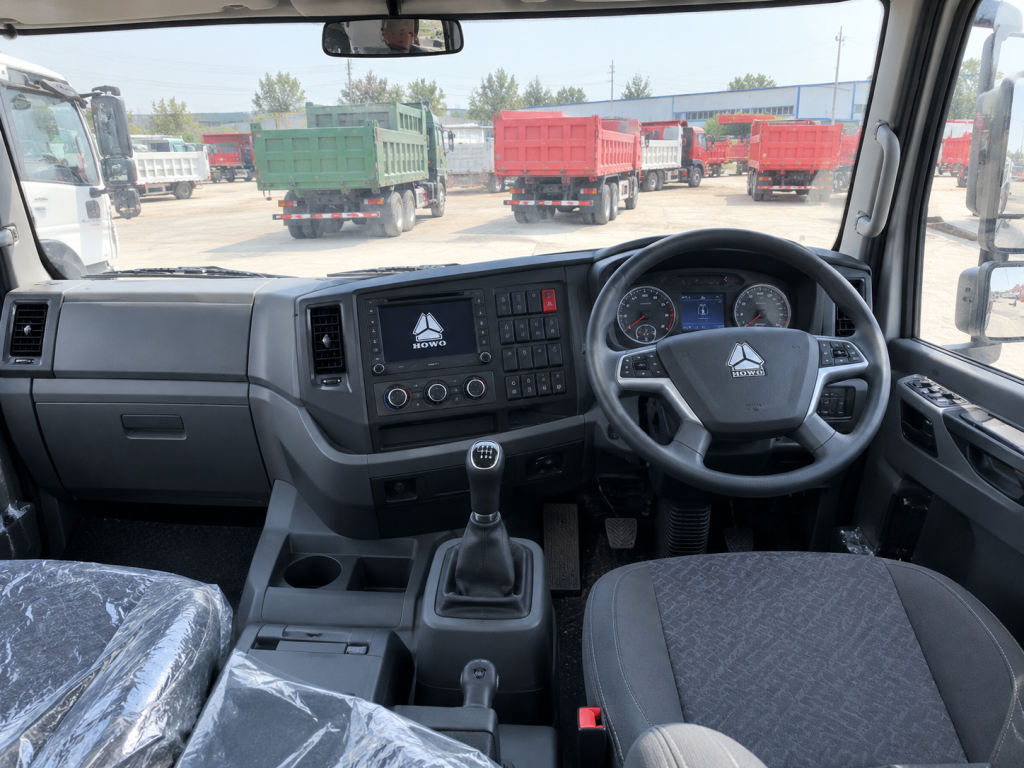
In fact, China can supply RHD. HOWO 371 and 380, Shacman F3000 and X3000, and FAW J6P were all built in right-hand-drive for African and South Asian markets, so the steering box, column and harness exist as catalogue parts. A conversion with factory parts runs $2,250–4,600 and takes 5–10 days; a new factory RHD unit is $38,000–48,000 CIF. On the used side, a documented conversion sells at a 10–15% discount against a factory RHD unit of the same year, because the next buyer carries the same doubt you did. Our RHD guide walks through the parts list and the seven failure points.
In contrast, what China cannot supply is a used Japanese RHD truck, because it never built one. If you want a 2017 Hino 500 or an Isuzu FVR, the stock is in Japan, Singapore or a Dubai yard, at $18,000–35,000 depending on year and condition. For a Kenyan buyer working to the 8-year rule — 2019 or newer — that stock gets expensive fast, which is exactly why so many Nairobi buyers end up comparing a converted Chinese unit against a Japanese one. We wrote the whole comparison in Chinese vs Japanese trucks for Africa.
Shipping: How Fast Used Trucks from China vs Dubai Arrive
Indeed, this is Dubai’s second real advantage, and unlike the price story it survives scrutiny. Jebel Ali sits on the same eastbound lanes that serve East Africa, so a truck in a Dubai yard can be in Mombasa in ten days. Meanwhile, the same truck from Tianjin has to come around or through the Indian Ocean first.
| Destination port | From Tianjin / Shanghai | From Jebel Ali | Difference |
|---|---|---|---|
| Mombasa | 25–33 days | 10–15 days | ~2 weeks |
| Dar es Salaam | 28–35 days | 12–18 days | ~2 weeks |
| Lagos (Apapa / Tin Can) | 35–40 days | 24–30 days | ~10 days |
| Tema | 32–38 days | 22–28 days | ~10 days |
| Durban | 28–35 days | 14–20 days | ~2 weeks |
Likewise, freight follows the same logic: RoRo from China to Lagos runs $2,500–4,000 per truck in 2026, while the Jebel Ali leg is roughly half that. Full port-by-port numbers are in the shipping cost guide.

So run the arithmetic properly, with a real unit and a real port. Same 2019 HOWO 371 tipper, same condition, cleared in Mombasa:
| Cost line | Bought in China | Bought in Dubai |
|---|---|---|
| Truck, ex-works | $15,000 | $19,000 |
| Ocean freight + insurance | $3,000 | $1,700 |
| CIF Mombasa | $18,000 | $20,700 |
| Duty, VAT, levies (≈50–55%) | $9,000–9,900 | $10,350–11,400 |
| Clearing agent + port + delivery | $900 | $900 |
| Landed in Nairobi | $27,900–28,800 | $31,950–33,000 |
| Time from payment to port | 6–8 weeks | 4–5 weeks |
Overall, the two routes land about $4,000 apart, and two to three weeks apart. If the truck is replacing one that already earns, those weeks are not free: a tipper on construction work bills roughly $150–250 a day in Kenya, so three weeks is $3,000–5,000 of revenue. In that specific case the Dubai route can break even, and occasionally win. If the truck is going into stock, or you are buying three of them, the two weeks cost you nothing and the $12,000 does.
What Dubai Does Better, Honestly
- First, speed. Stock is already afloat or in a yard, so you can be loading within a week of paying.
- Second, small lots. Nobody in Tianjin wants to inspect, photograph and export a single $9,000 pickup. Dubai traders do it all day.
- Third, physical inspection. If you can fly to the UAE, you can put your hands on the truck before you pay. That is worth real money to a first-time buyer.
- Also, Japanese and European RHD stock. Genuine supply that China simply does not have.
- Finally, familiar paperwork for banks. Some African banks and LC desks see Jebel Ali documents more often than Tianjin ones, and familiarity shortens arguments.
What China Does Better
- First, price at source. No storage layer, no second handling, no trader margin — and therefore a lower CIF and a lower duty bill.
- Second, depth of choice. Forty units of the same model in one yard, so you can reject the first ten and still fill the order.
- Third, upfitting. Tipper bodies, water bowsers, fuel tankers and crane bodies are built next door, not shipped in and modified. See the vehicle types we build most often.
- Then there is parts reality in Africa. HOWO, Shacman and FAW parts are on the shelf in Lagos, Nairobi and Dar es Salaam. A Chinese truck bought through Dubai still has that advantage — but the Dubai premium bought you nothing.
- Lastly, inspection transparency. We can send a cold-start video, a compression test and a 30-point report before you commit, because the truck is ours and it is here. The 30-point checklist is the same one our buyers use on site.
How to Verify a Seller in Either Market
So here are six checks, in this order. They work on a Shijiazhuang exporter and on an Al Aweer trader alike.
- First, the VIN on the document must match the chassis stamp. Not the photo of the stamp — a video, filmed today, with the door frame and the dashboard in the same shot.
- Second, ask who owns the goods. The name on the invoice should be the name on the bill of lading and the name on the bank account. Three different companies means three different stories later.
- Then demand a cold start. First start of the day, no warm-up edit. Smoke that clears in ten seconds is normal; smoke that stays is a $2,000 problem.
- After that, third-party inspection if the value justifies it. $100–300 buys an independent report and removes the argument.
- Next, check the export document trail. From China you should see an export licence held by a licensed exporter, a customs declaration and a B/L in your consignee name. From Dubai you should see the original export certificate from the country of manufacture, plus the re-export declaration.
- Finally, verify the company, not the WhatsApp number. Trade licence or business licence, address, and a video call from the yard. Our own checks are set out in 10 red flags when buying used trucks from China.
Above all, one more check belongs to this comparison specifically. When you compare used trucks from China vs Dubai, ask the Dubai seller for the Chinese export declaration if the unit is a Chinese brand. If he cannot produce it, he did not buy it from the factory, and the price he is asking has at least two margins in it.
Which Route Fits Your Order
| Your situation | Best route | Why |
|---|---|---|
| First import, one truck, LHD market | China, with third-party inspection | Lowest landed cost; the inspection replaces the trip you cannot take |
| First import, one truck, RHD market, budget under $25k | China, documented conversion | Japanese RHD stock at that budget is usually 2013–2015 and fails the 8-year rule |
| RHD market, budget $30k+, want a Japanese badge | Japan-direct or Dubai | China cannot supply it; compare Dubai speed against Japan price |
| Dealer stocking 3–10 units | China, one consolidated order | One inspection standard, one B/L, freight shared; see the fleet order guide |
| Replacement truck, downtime costing money now | Whichever is physically closer | Two weeks of revenue can outweigh a $4,000 price gap |
| Mining or construction fleet, mixed types | China | Tipper, water, fuel and crane bodies from one supplier, one spare-parts list |
If you are still choosing between models rather than routes, the tractor truck buyer’s guide and the prime mover guide cover the 4×2 versus 6×4 decision, and the price guide gives current ranges by type.
FAQ: Used Trucks from China vs Dubai
Is it cheaper to buy used trucks from China or Dubai?
For a Chinese-brand truck, China is cheaper by roughly $3,000–6,000 per unit once the Dubai trader’s margin and double handling are counted. For a Japanese right-hand-drive truck, China is not a source at all, so the comparison is Japan-direct against Dubai, and Dubai usually costs 8–20% more for the convenience of local stock.
Do I pay import duty twice if I buy through Dubai?
Not twice at the same rate, but you do pay more once. Duty and VAT are charged on the CIF value at your destination port, and a truck bought through Dubai carries a higher CIF because the trader’s margin is inside it. In Nigeria that adds roughly 40–45% of the difference in duty; in Kenya, 50–55%.
Can I buy a right-hand-drive truck from China?
Yes. HOWO 371 and 380, Shacman F3000 and X3000, and FAW J6P were built in RHD for export markets, so a factory-parts conversion costs $2,250–4,600 and takes 5–10 days. A new factory RHD unit runs $38,000–48,000 CIF. What China cannot supply is a used Japanese RHD truck.
How long does shipping take from Dubai versus China to Mombasa?
Jebel Ali to Mombasa is about 10–15 days, while Tianjin or Shanghai to Mombasa is 25–33 days. At the same time, add 1–3 weeks at either end for loading, clearance and inland delivery, which is why total door-to-yard time is usually 4–5 weeks from Dubai and 7–9 weeks from China.
Is a Dubai truck better maintained than a Chinese one?
Not inherently. A Dubai yard truck has usually been driven in the Gulf, which means good roads and hard heat; a Chinese truck has usually come off a domestic fleet with a service record in the registration file. Condition depends on the individual unit and the inspection, not the postcode.
What if the Dubai price is lower than yours?
Ask for the CIF price at your port, in writing, with freight, insurance and destination charges included, and the year of first registration on the invoice. Then compare that number to ours. Usually the gap closes or reverses. If it does not, buy from Dubai — a lower true landed cost is a lower true landed cost, and I would rather tell you that than lose your trust on the second order.
Bottom Line
- Dubai is a warehouse, not a source. For Chinese trucks you are paying a 10–25% layer for stock that came from Tianjin in the first place.
- Worse, that layer gets taxed again at your port, because duty is charged on a CIF value that already contains it.
- Still, Dubai’s two real advantages hold: speed — about two weeks to East Africa — and genuine Japanese RHD stock. Both are worth paying for in the right situation.
- For fleet orders, LHD markets and anything Chinese-branded, buying at source wins on landed cost by a margin that pays for a second truck every fourth order.
If you are holding two quotes — one from a Dubai yard, one from China — send both to us on WhatsApp at +86 157 1768 7720 with the word COMPARE. We will put them side by side at the same Incoterm, same port, same year, and tell you which one is actually cheaper. Sometimes the answer is not us.
Watch — Chinese vs Japanese Trucks, Real CIF Numbers
This 30-second clip puts a $15,000 Chinese tractor next to a $30,000 Japanese one at CIF, which is the same decision most RHD buyers face when a Dubai yard quotes them a Hino or an Isuzu: watch on YouTube.
About the Author
Bean Wang is the founder of HebeiCar, the trading name of Ziquan (Xingtai) International Trade Co., Ltd. The company exports used trucks from Yuanshi County, Shijiazhuang, Hebei, China. Since 2014 he has supplied more than 500 fleet owners and dealers across 20+ African countries with inspected HOWO, Shacman, FAW and FOTON trucks, and he spends more time than he would like answering quotations that turn out to be missing freight, insurance or a year of registration.
Related reading: how to import used trucks from China, age limits by country, importing into the UAE, the HOWO buyer’s guide, and real fuel consumption and cost per km.