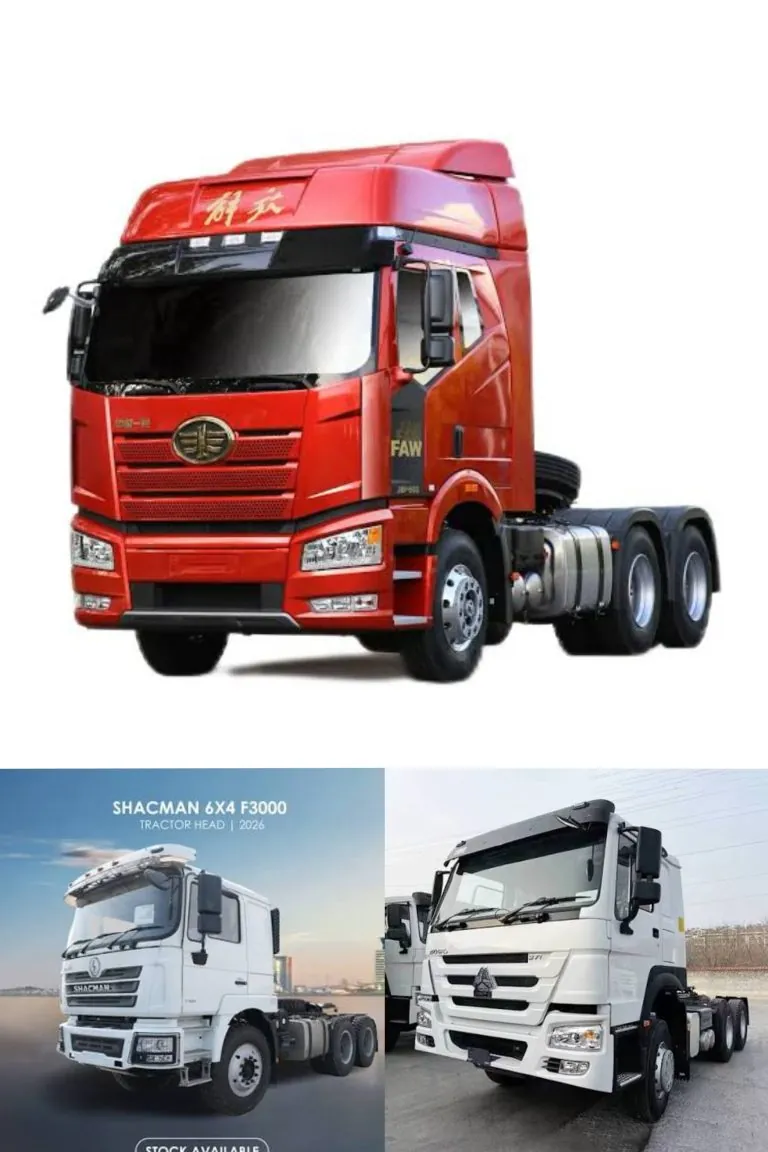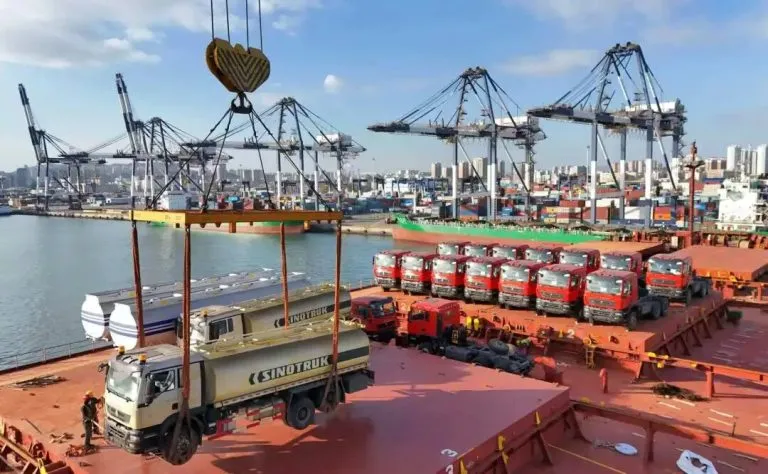
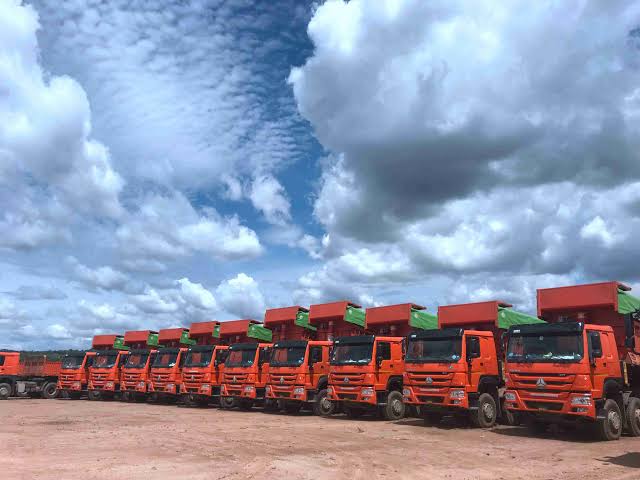
How Long Do Chinese Trucks Last in Africa? Real Lifespan & Maintenance Guide for HOWO, Shacman, FAW & Dongfeng (2026)
You have found a HOWO 371 from 2018 with 280,000 km on the clock. Price tag looks good. The engine sounds solid in the video your supplier sent. But a question keeps nagging you: how many more kilometers does this truck have left? In other words, you are really asking: how long do Chinese trucks last in Africa — and can you trust the mileage you are being quoted?
This is the single most important question every African buyer asks — yet most suppliers dance around it. They will tell you “Chinese trucks last long” without giving you numbers you can actually use to make a decision.
After exporting hundreds of used Chinese trucks to Africa — and tracking how they perform on the ground — here is the real data on how long HOWO, Shacman, FAW, and Dongfeng trucks actually last, what breaks first, and what you can do to double their working life.
Prefer to see them in action? Watch our vehicle inventory walkarounds on YouTube — real trucks, real conditions, no filters.
Chinese Truck Lifespan at a Glance — By Brand
Let us start with the headline numbers. We gathered these figures from fleet operators and service records across West, East, and Southern Africa — not from lab tests or marketing brochures.
| Brand | Avg. Lifespan (Years) | Avg. KM Before Major Overhaul | Total KM Potential | Best Use Case |
|---|---|---|---|---|
| HOWO (Sinotruk) | 12–15 years | 600,000–800,000 km | 1,000,000–1,500,000 km | Mining, heavy construction, long-haul |
| Shacman (Shaanxi) | 10–14 years | 500,000–700,000 km | 800,000–1,200,000 km | Quarry, rough terrain, heavy loads |
| FAW | 10–13 years | 500,000–650,000 km | 800,000–1,000,000 km | Highway logistics, container transport |
| Dongfeng | 10–12 years | 400,000–600,000 km | 700,000–900,000 km | Medium-duty, regional distribution |
| FOTON | 8–12 years | 400,000–550,000 km | 600,000–800,000 km | Light/medium duty, urban delivery |
How Chinese Truck Lifespan Compares to Japanese and European Trucks
Let us be honest — Chinese trucks do not match European or Japanese trucks on raw longevity. A Volvo FH or Scania R-series can push 2 million km with proper maintenance. Similarly, a Hino or Isuzu from Japan regularly hits 800,000–1,200,000 km.
However, here is what the numbers do not tell you: purchase price.
A used HOWO 371 tractor head costs $18,000–$28,000 CIF Lagos. A used Scania of similar year and condition? $45,000–$65,000. A used Hino? $30,000–$45,000.
When you calculate cost per kilometer over the truck’s lifetime, Chinese trucks often come out ahead — especially when you factor in cheaper spare parts and wider mechanic availability across Africa.
We covered this in more detail in our Chinese vs Japanese trucks comparison if you want the full breakdown.
What Actually Breaks First on Chinese Trucks in Africa?
Speaking to fleet managers in Nigeria, Ghana, Kenya, and Tanzania, the pattern is remarkably consistent. Here is what tends to fail first and at what mileage:
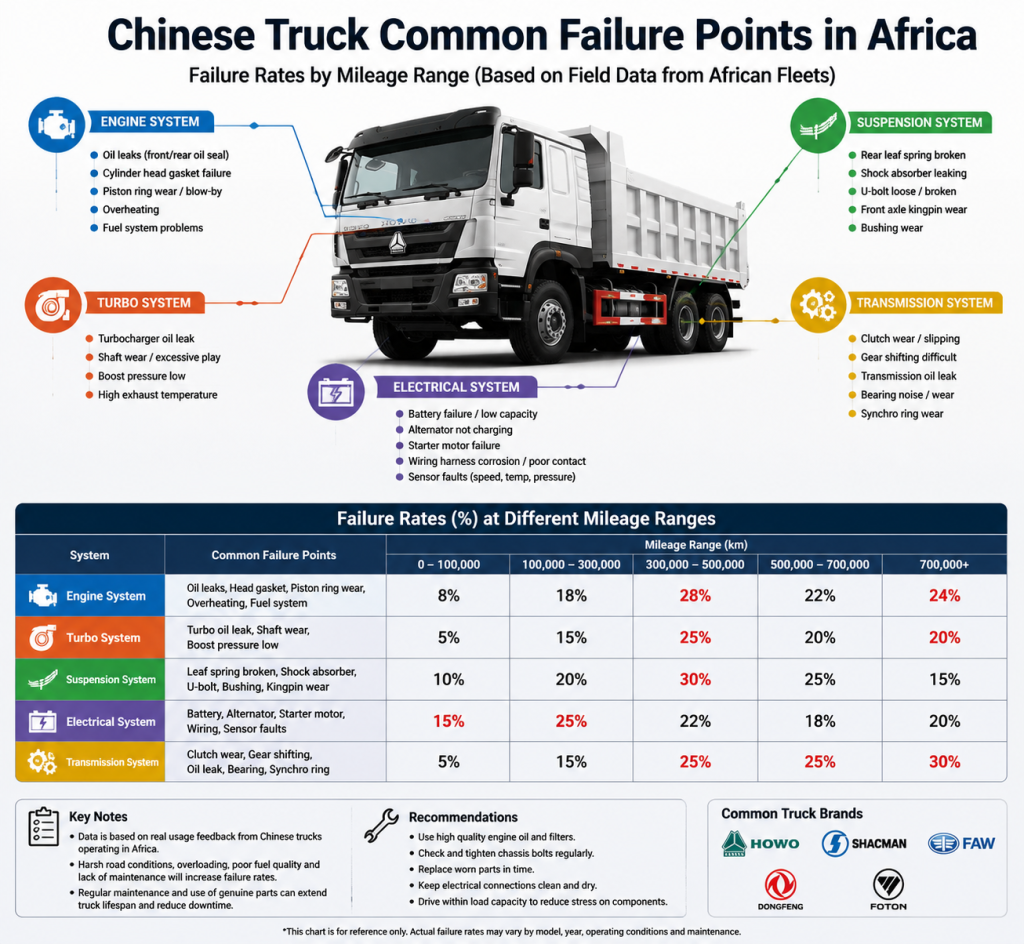
- Suspension and bushings (150,000–250,000 km) — This is the #1 failure point. African road conditions, especially on mining sites and feeder roads, destroy bushings and shock absorbers fast. Budget for suspension work every 2 years.
- Turbocharger (200,000–350,000 km) — In most cases, delayed oil changes or poor air filtration in dusty environments cause this failure. A replacement turbo for a HOWO WD615 engine costs around $400–$800.
- Fuel injectors and injection pump (250,000–400,000 km) — Low-quality diesel in many African markets is the main culprit. A set of injectors runs $200–$500.
- Clutch assembly (200,000–350,000 km) — Heavy loads and stop-start traffic in cities like Lagos and Nairobi wear clutches faster than highway operations.
- Electrical system (300,000–500,000 km) — Wiring harnesses, sensors, and the ECU can develop issues. This is less mechanical failure and more corrosion or heat damage.
- Gearbox or transmission (400,000–600,000 km) — Most Chinese trucks use Eaton or Fuller-style manual transmissions that are robust provided the clutch is used properly.
- Engine bottom end (500,000–800,000 km) — The WD615 (HOWO) and WP series (Shacman) engines typically need their first major overhaul in this range. With good maintenance, some go past 900,000 km.
Brand-by-Brand: What Owners Say About Chinese Truck Lifespan
HOWO (Sinotruk) — The Workhorse
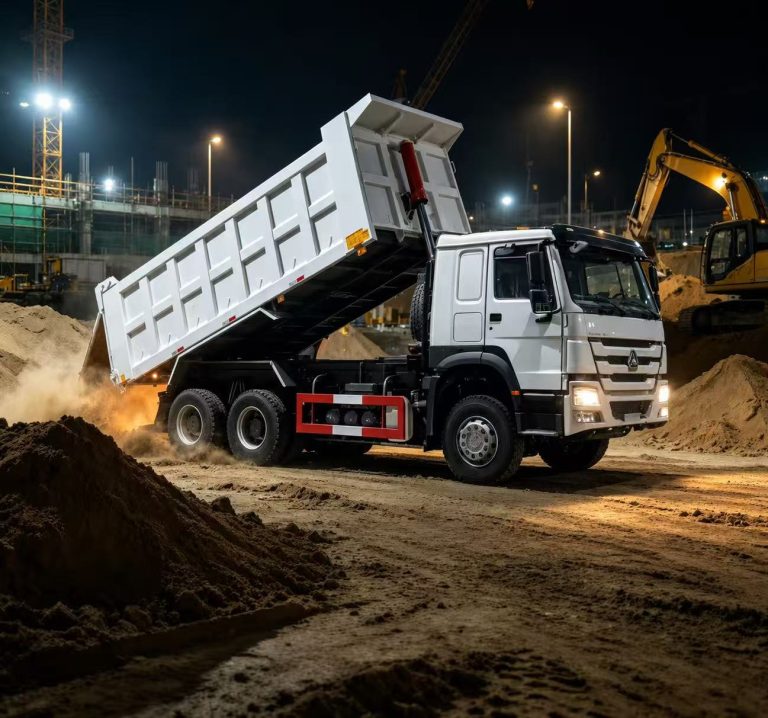
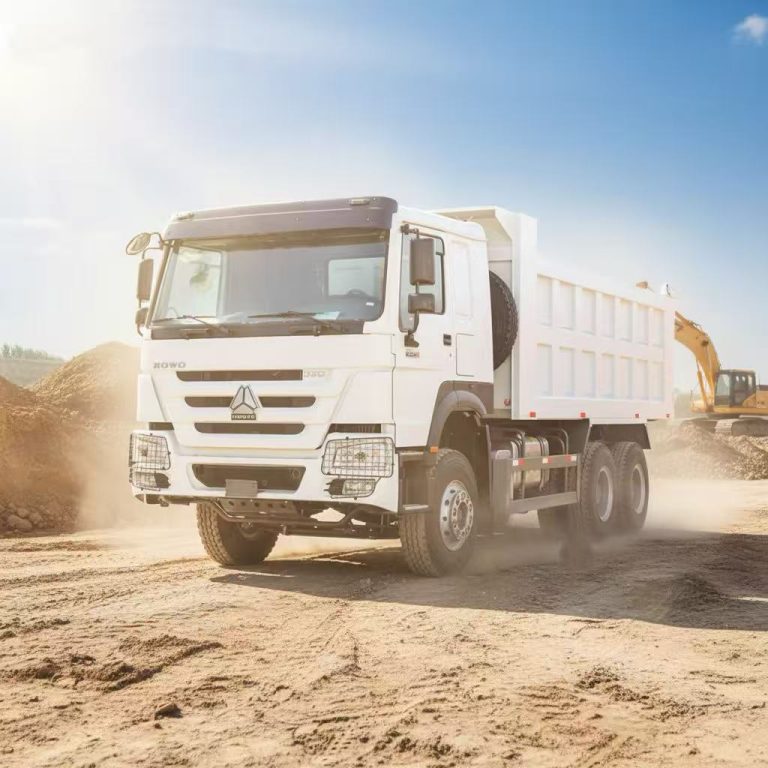
HOWO is the most common Chinese truck on African roads for a reason. Parts are everywhere — from Lagos to Lusaka. Moreover, most mechanics know how to work on them. The WD615 engine (licensed from Steyr, Austria) is proven and rebuildable.
Owner feedback: “I bought a 2016 HOWO 371 dump truck in 2022 with 320,000 km. In 2026, it has 680,000 km. Only major work was a turbo replacement at 410,000 km and a clutch at 500,000 km.” — Fleet operator, Nigeria.
Check our complete HOWO buyer’s guide and HOWO 371 specs page for detailed model info.
Shacman — The Terrain Specialist
Shacman trucks use a MAN technology license and perform particularly well in mining and construction. They handle rough roads better than HOWO, according to many operators. However, parts are slightly less available outside major cities.
Owner feedback: “Our Shacman F3000 has been hauling granite in a quarry near Mombasa since new in 2018. 450,000 km, one clutch change and suspension bushings twice. The frame is still solid.” — Quarry manager, Kenya.
See our Shacman buyer’s guide and Shacman F3000 guide for specs and pricing.
FAW — The Highway Runner
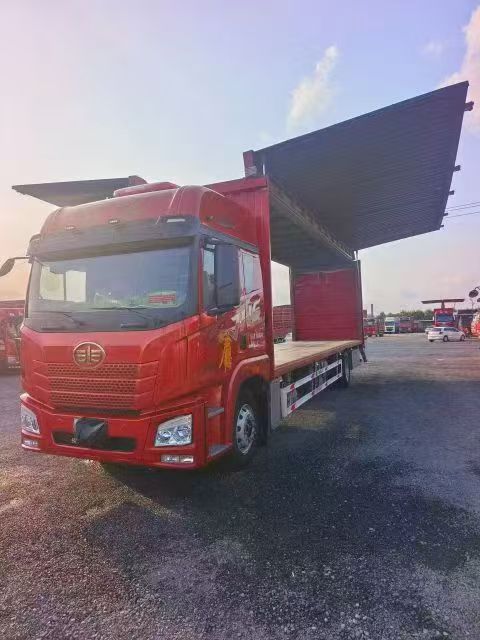
Most operators consider FAW trucks the most fuel-efficient of the Chinese brands for highway use. Their J6 series, with the CA6DM engine, is popular for long-haul logistics. The caveat: FAW’s dealer network in Africa is thinner than HOWO’s. Nevertheless, their highway lifespan is competitive.
Owner feedback: “We run 8 FAW J6 tractor trucks on the Nairobi-Mombasa corridor. Average fuel consumption is 32L/100km loaded. Two trucks have passed 600,000 km with no engine issues.” — Logistics company, Kenya.
Our FAW buyer’s guide covers all models and pricing.
Dongfeng — The Reliable Mid-Range
Buyers often overlook Dongfeng in favor of HOWO and Shacman, but it has a solid reputation in Central and West Africa, especially in former French colonies (DRC, Cameroon, Côte d’Ivoire) where the brand has a historic presence. That said, parts are less standardized, so factor that into your plans.
See our Dongfeng buyer’s guide for a full model rundown.
FOTON — The Light-Medium Specialist
FOTON competes more in the light-to-medium duty segment. Their Auman series (heavy duty) is less common than HOWO or Shacman but still offers competitive pricing. Parts availability is the main concern — significantly thinner than HOWO’s network.
Read our FOTON buyer’s guide for details.
The #1 Factor That Determines How Long Your Chinese Truck Lasts
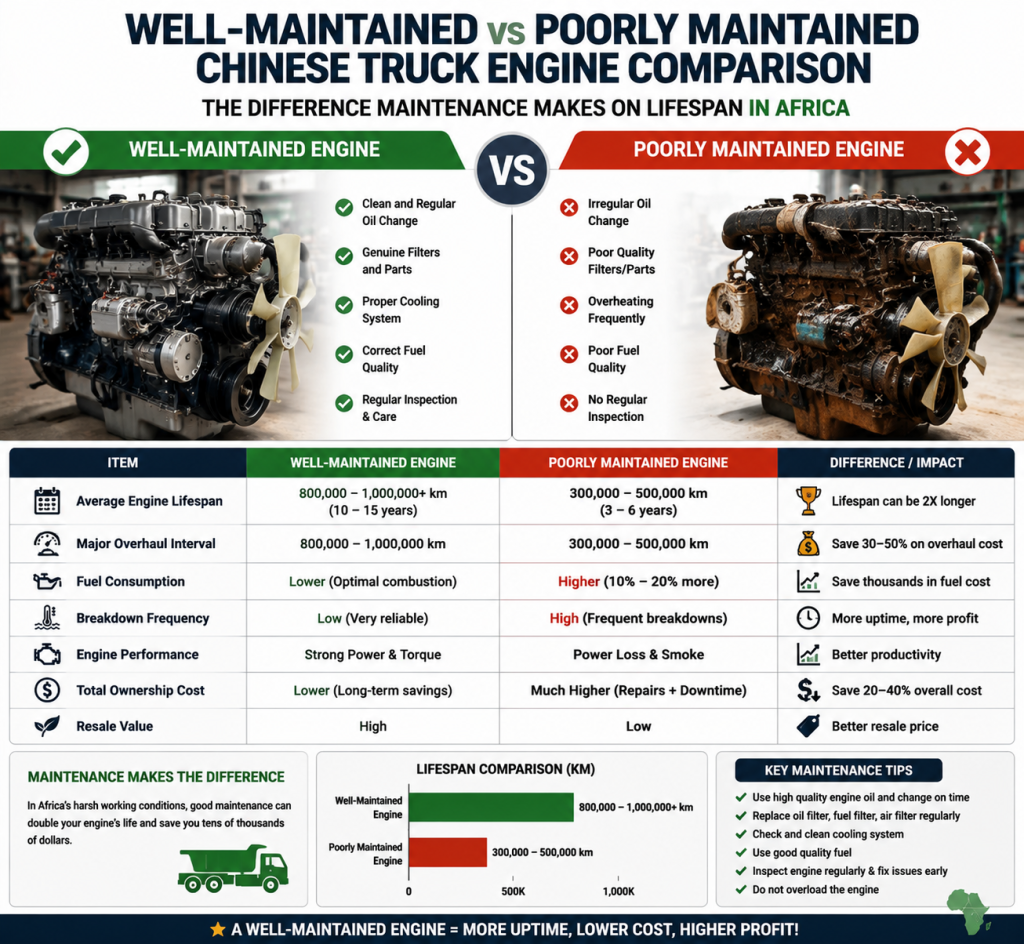
If you take away only one thing from this article, let it be this: maintenance schedule is more important than brand choice.
We see the same pattern repeatedly. Two identical HOWO 371 trucks bought at the same auction in Shanghai. One is still running strong at 700,000 km. The other needed a new engine at 350,000 km. The difference? Oil changes every 10,000 km versus whenever the driver remembered.
Maintenance Schedule That Maximizes Lifespan
Here is the maintenance schedule that experienced fleet operators in Africa follow for Chinese trucks:
| Interval | What to Do | Estimated Cost (USD) |
|---|---|---|
| Daily | Check engine oil, coolant, brake air pressure, tire pressure, lights | Free (5 minutes) |
| Every 10,000 km | Engine oil + filter change, fuel filter check, chassis lubrication | $150–$250 |
| Every 20,000 km | Replace fuel filter, check air filter, inspect brake pads and drums | $100–$200 |
| Every 50,000 km | Replace air filter, transmission oil change, differential oil change, check turbo | $300–$500 |
| Every 100,000 km | Replace coolant, brake fluid, inspect injectors, valve clearance adjustment | $400–$700 |
| Every 200,000 km | Overhaul brake system, replace wheel bearings, check gearbox condition | $800–$1,500 |
| Every 500,000+ km | Consider engine overhaul: piston rings, bearings, cylinder head rebuild | $3,000–$6,000 |
We have a full guide on Chinese truck spare parts in Africa that covers where to source quality components and what to watch out for when buying parts locally.
African Climate Is Tough on Trucks — Here Is What to Adapt
Chinese truck manufacturers design and test their vehicles in Chinese conditions, then ship them to Africa. The operating environment in most African markets differs significantly:
- Heat: Ambient temperatures above 40°C in the Sahel region put extra strain on cooling systems and batteries. Many trucks arrive with coolant rated for temperate climates — replace it with a high-temperature coolant immediately.
- Dust: On unpaved roads (common in mining areas and rural routes), air filters clog 3–5 times faster than in China. Carry spare filters and check every 3,000 km in dusty conditions, not 10,000.
- Fuel quality: Diesel in many African markets has higher sulfur content than Chinese diesel. This accelerates injector wear and oil degradation. Therefore, use fuel additives or increase oil change frequency if you cannot source low-sulfur diesel.
- Overloading: It happens. Chinese trucks are built with some margin, but consistently running 20–30% over rated load will cut lifespan by half on suspension and frame components.
Does Truck Age or Mileage Matter More When Buying Used?
Short answer: mileage matters more than year.
A 2016 HOWO with 250,000 km is a better buy than a 2020 HOWO with 500,000 km. Here is a rough guide to what different mileage ranges mean for a Chinese used truck exported to Africa:
| Mileage Range | Condition Assessment | Expected Remaining Life | Recommendation |
|---|---|---|---|
| 100,000–250,000 km | Excellent — truck is barely broken in | 10–12+ years / 500,000+ km | Best value, worth paying premium |
| 250,000–400,000 km | Good — halfway through first lifecycle | 7–10 years / 300,000–500,000 km | Good buy if price reflects it |
| 400,000–600,000 km | Fair — nearing major service milestones | 5–7 years / 200,000–400,000 km | Only if well-maintained, factor in repairs |
| 600,000–800,000 km | High mileage — major components may fail | 3–5 years / 100,000–200,000 km | Use for short-term, budget-constrained ops |
| 800,000+ km | End of life — expect engine overhaul soon | 2–3 years / 50,000–100,000 km | Not recommended unless barely used in final years |
For a step-by-step walkthrough of what to check before you buy, read our guide to finding a reliable Chinese supplier and our scam prevention guide.
How the 180-Day Export Rule Affects Your Truck’s Condition
Many African buyers do not realize that Chinese used trucks enter the export market through the 180-day temporary registration system. A truck manufacturer or dealer registers the vehicle in China, drives it for less than 180 days (sometimes zero kilometers — these are called “zero-km used trucks”), and then exports it as “used.”
Consequently, some low-mileage trucks you see are practically new, while others with genuine 300,000+ km have been worked hard in Chinese domestic conditions before export.
We wrote a full explanation of how this system works in our article on China’s 180-day export rule.
How Much Should You Budget for Repairs in Year 1?
For Chinese used trucks arriving at an African port, here is a realistic Year 1 maintenance budget by truck type:
| Truck Type | First Year Repair Budget | Typical Work Required |
|---|---|---|
| Dump truck (construction/mining) | $2,000–$4,000 | Suspension bushings, hydraulic check, tires, lights |
| Tractor truck (long-haul) | $1,500–$3,000 | Clutch check, brake pads, electrical fixes, tires |
| Cargo truck (distribution) | $1,000–$2,500 | Routine service, brake adjustment, tire replacement |
| Fuel tanker | $2,000–$3,500 | Pump inspection, valve seals, brake system check |
| Concrete mixer | $2,500–$4,500 | Hydraulic system service, drum gear check, engine service |
Signs That a Used Chinese Truck Was Well-Maintained
When you view a truck (in person or via video walkaround from your supplier), these signs indicate a truck that the previous owner cared for:
- Service records exist. A supplier who provides maintenance logs is worth trusting. Ask for them before you even discuss price.
- Same-brand tires. A mix of cheap Chinese retreads is a red flag. Consistent tire brand suggests consistent maintenance habits.
- Engine bay is clean. Not showroom clean — that is suspicious. However, reasonable cleanliness indicates the driver cared.
- No oil leaks from major seals. Minor seepage is normal, but active dripping from the front or rear main seal means expensive labor ahead.
- Turbo whistle is clean. A labored, whining turbo suggests wear, whereas a smooth whistle is a good sign.
- Clutch bite is firm. A spongy or high-biting clutch means replacement is coming soon.
When Is It Better to Buy a Higher-Mileage Truck?
Counterintuitive as it sounds, there are situations where a higher-mileage Chinese truck makes more sense than a low-mileage one:
- Known operating history: A 400,000 km truck with full service records from a known fleet is often a safer buy than a 150,000 km truck with no history. The lower-mileage truck might have been sitting for 2 years or had its odometer adjusted.
- Engine type matters: The HOWO WD615 engine is more rebuildable and has cheaper parts than newer common-rail engines. As a result, a high-mileage WD615 is a lower-risk bet than a low-mileage newer engine type with no local parts support.
- Resale business: If you plan to sell the truck in Africa after 2–3 years, the purchase price matters more than the absolute mileage. A cheaper, higher-mileage truck can still be profitable provided you price it right and keep maintenance minimal.
Frequently Asked Questions
How Far Can a HOWO or Shacman Go Before Needing an Overhaul?
A well-maintained HOWO dump truck typically lasts 600,000–800,000 km before needing a major engine overhaul. With proper maintenance at the overhaul point, many trucks push past 1,000,000 km total. The frame and chassis on HOWO trucks are robust — it is the engine and drivetrain that set the ceiling.
Is Shacman More Durable Than HOWO for Mining Work?
Many mining operators in Zambia and DRC prefer Shacman for rough terrain because the MAN-derived chassis and suspension handle constant vibration better. However, HOWO has significantly better parts availability. For a mine far from major cities, HOWO wins because of parts access. For a mine near a city with Shacman dealers, Shacman may be better.
What Is a Good Mileage for a Used Truck from China?
For Chinese heavy trucks, 100,000–250,000 km is the sweet spot. Trucks in this range are broken in, priced reasonably, and have significant remaining life. Under 100,000 km commands a premium that rarely makes financial sense for the African resale market.
Can a Chinese Truck Last 15 Years in Africa?
Yes — but only with consistent maintenance. A 2010 or 2011 HOWO truck that the owner properly maintained can still run in 2026. We see this regularly in less-demanding roles like short-haul logistics and construction site support. For heavy mining or long-haul operations, 10–12 years is more realistic.
Do Chinese Trucks Have Engine Problems in Africa?
The most common engine issue relates to fuel quality, not the engine itself. Chinese engines (WD615, WP10, WP12, YC6L) are solid designs — many license technology from European manufacturers like Steyr, MAN, and Cummins. The problem is that poor fuel and delayed oil changes accelerate wear. Use quality oil, change it on schedule, and these engines perform well.
Where Can I Find Spare Parts for My Chinese Truck in Africa?
HOWO parts are available in most African capitals. Shacman, FAW, and Dongfeng parts need more searching but are stocked in major cities. Our spare parts guide has detailed information on where to find quality components in each market.
Final Take: What to Do Next
Here is the practical takeaway:
- Set your mileage range first. Decide what remaining life you need and filter trucks by mileage, not year. 150,000–300,000 km is the best value band for Chinese trucks heading to Africa.
- Factor in first-year repairs. Budget $1,500–$4,000 for immediate post-arrival maintenance. Do not spend your last dollar on the truck itself — leave room for repairs.
- Check engine type. If you are in a remote area, make sure the engine in the truck you are buying has local parts support. HOWO’s WD615 and Shacman’s WP series are your safest bets.
- Get a walkaround video. Ask your supplier to show you specific things: engine cold start, turbo whistle, clutch feel, suspension bushings, undercarriage. A legitimate supplier who wants repeat business will do this.
- Plan your spare parts strategy before the truck arrives. Identify local suppliers or import a starter kit of critical spares (filters, belts, seals, injectors) with the truck.
If you are ready to start looking, browse our current inventory or contact us with your requirements — we can match you with trucks that fit your budget and expected lifespan needs.
For a closer look at real trucks before you buy, visit our YouTube channel — we post walkaround videos showing engine condition, chassis, and interior of every truck we list.
Related reading:
- Weichai vs Cummins vs Yuchai: Chinese Truck Engine Comparison
- Used Truck Inspection Guide — What to Check Before Buying from China
- 5 Costly Mistakes African Buyers Make When Importing Used Trucks
- Used Truck Shipping Costs from China to Africa
- How to Pay for Used Trucks from China: LC, TT & Safety Guide
About the Author
Wang Jianbin is the founder of HebeiCar (hebeicar.com), a China-based used truck exporter. Since 2014, he has helped 500+ fleet owners and dealers across 20+ African countries — Nigeria, Ghana, Kenya, Tanzania, Zambia, DRC, Ethiopia and more — source quality used HOWO, Shacman, FAW and FOTON trucks at factory-direct prices. Every truck is inspected in his own yard in Shijiazhuang, Hebei before shipping, and he writes about import procedures, shipping logistics, customs clearance and truck selection based on that real export experience.
Watch real inventory walkaround videos on the YouTube channel, or contact Wang Jianbin directly for current inventory and CIF prices via WhatsApp.