How to Check Accident & Vehicle History of Used Trucks from China — VIN Guide 2026
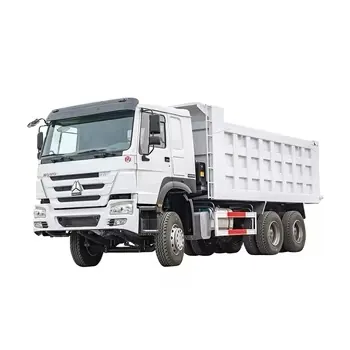
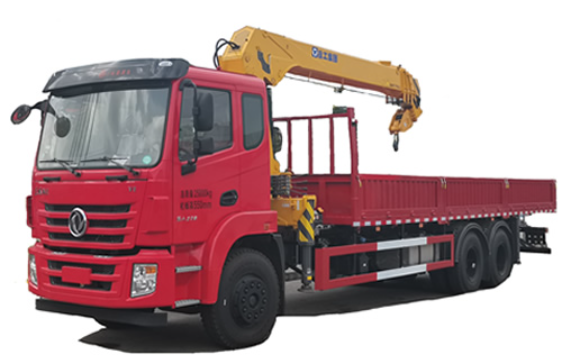
Yes, you can check. Checking a used truck accident history in China is not locked behind some government database — you just need the VIN and the right tools. In this guide I’ll walk you through the five ways we actually use to verify a truck before it ships, how to read the reports once you have them, and the six red flags that have saved our buyers (and us) from expensive mistakes. This is the same process we run on every HOWO, Shacman, FAW or FOTON that leaves our yard in Yuanshi County, Shijiazhuang.
Why accident history decides whether your truck is a bargain or a trap
Here’s the part nobody tells you on the first call: rebuilt accident trucks are the biggest single source of margin in used truck export. A 2019 HOWO 371 that rolled or hit something hard sells for almost nothing at Chinese auction — maybe $4,000–5,000 under normal market value. A workshop buys it, replaces the cab, pulls the frame straight, sprays paint over everything, and the truck looks brand new. Repair cost: $6,000–8,000. Selling price after that: full market value. That’s an $8,000–15,000 gap, and it’s why some exporters push “great deals” so hard.
For you, the buyer, the problem is timing. You don’t find out the truck was rebuilt until it lands in Lagos, Dar es Salaam or Nairobi — after you’ve already paid for freight, insurance and customs. By then you’ve sunk 30–40% extra into a truck that’s worth half of what you paid. That’s not a bad deal. That’s a trap.
The good news: all of this is checkable before you pay a cent. Let’s start with the first step.
First, find the VIN — and understand what it tells you
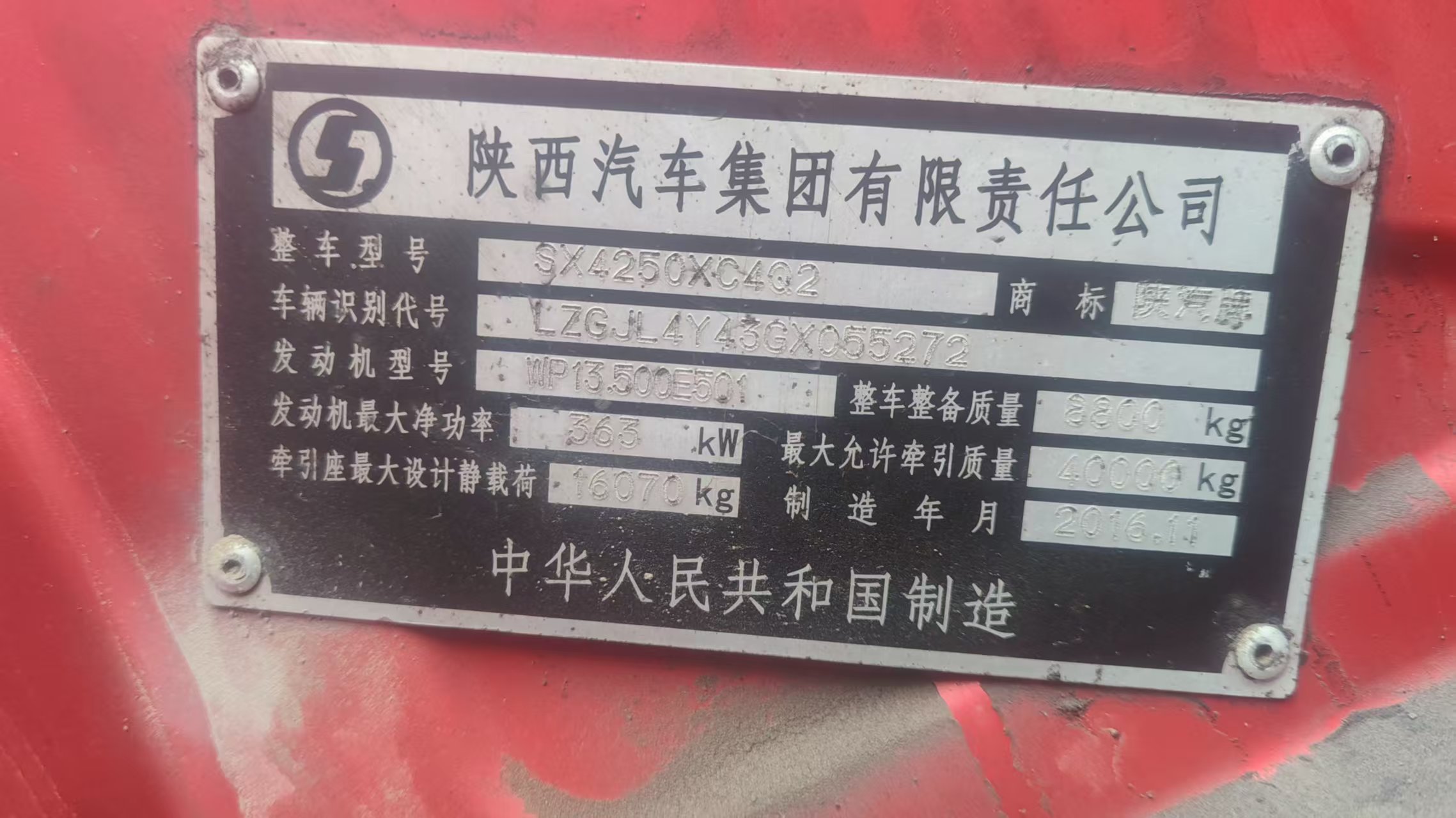
Every truck has a 17-character Vehicle Identification Number, and it’s stamped in three places you can verify against each other: on a metal plate inside the driver’s door frame, visible through the bottom corner of the windshield, and stamped directly into the chassis frame rail. If any of the three don’t match — walk away, that alone tells you the truck has been through something.
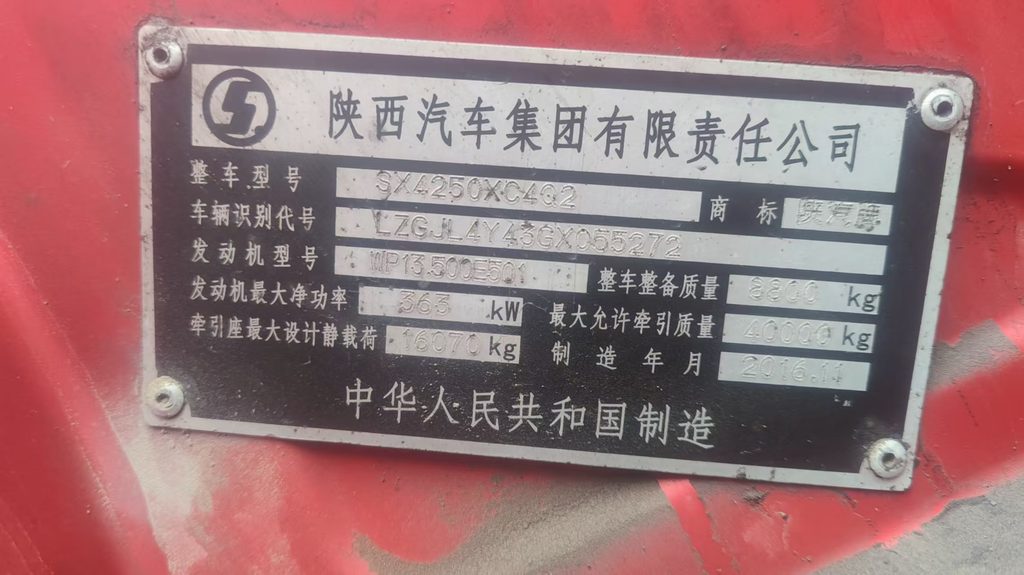
Here’s what the 17 characters actually mean, broken down simply:
| Characters | What they code | Why it matters to you |
|---|---|---|
| 1–3 | World Manufacturer Identifier (WMI) | Tells you the real factory. LZZ = Sinotruk (HOWO), LZG = Shacman, LFW = FAW, LVBV = FOTON, LGW = Great Wall |
| 4–8 | Vehicle descriptor (engine, cab type, 6×4 or 8×4 drive) | Confirms the spec matches what the seller advertised |
| 9 | Check digit | Validates the whole VIN — if it doesn’t compute, the VIN was altered |
| 10 | Model year | Cross-check against the registration date and what you were told |
| 11 | Assembly plant | Which Chinese factory built it |
| 12–17 | Serial number | Unique to this truck — useful for record lookup |
You can paste any VIN into the free VIN decoder run by the US National Highway Traffic Safety Administration and it will confirm manufacturer, model year and specs in seconds. It won’t show accident history — no public decoder does — but it verifies the truck is what the seller claims it is, which is step one.
What an “accident record” actually means in China
Before you start checking, you need to understand there are two separate records, and people mix them up all the time:
- Insurance claim records (出险记录) — every claim paid out on the truck, with date and amount. Small claims of a few hundred to a couple thousand RMB (scratch, bumper, paint) are normal and meaningless. Large claims or claims that mention frame, cab or airbag work are the ones that matter.
- 4S dealer maintenance records (维保记录) — service and repair history, but only work done at the brand’s official dealer network.
And here’s the insight that most guides get wrong: a gap in maintenance records is not proof of an accident. In China, once a truck passes its warranty period — usually 3 to 5 years — the vast majority of owners stop going to 4S dealers and switch to independent workshops that cost half as much. That’s why you’ll see a 2016 truck with perfect records up to 2019 and then nothing for six years. The truck wasn’t hidden away in a crash; the owner just stopped paying dealer prices. We’ve seen buyers walk away from perfectly good trucks over this, and we’ve also seen sellers use “full dealer records” as a sales trick when the real history was anything but clean.
So treat the two records as separate evidence, cross-check them, and judge each on its own.
How to Check Used Truck Accident History — Five Methods That Work
1. Ask the exporter to provide it (the strongest option)
For a used truck accident history check, the strongest option is the exporter himself. A legitimate exporter already holds the documents: the truck’s registration certificate, transfer/ownership records, insurance claim history, and dealer maintenance printouts. We pull these before we even buy a truck for stock — there’s no reason to pay for a rebuild we’d have to sell. If a seller hesitates, deflects, or says “don’t worry, we inspected it” without showing you anything, that hesitation is your answer.
2. Third-party check apps (if you want to verify yourself)
Chinese apps like 查博士 (ChaBoshi), 车况宝 (CheKuangBao) and 汽修宝 (QiXiuBao) generate paid reports from a VIN — we’re talking tens of RMB, a few dollars. You’ll need a Chinese phone number to register, which is the annoying part, but if you have a contact in China it takes five minutes. These are the same tools dealers use internally, and they pull from insurance and dealer databases.
3. Online accident-record lookup platforms
Platforms like 12365auto specialise specifically in accident and damage records. You submit the VIN (or plate), pay a small fee, and get a damage report back. It’s the closest thing China has to a public claims database, and it covers commercial vehicles, not just passenger cars.
4. Dealer maintenance records
With the VIN plus the plate number, a 4S dealer can look up the official service history. Some will do it over the phone, most want a visit — which is exactly why this is a job for the exporter to do before you commit, not something you should fly to China to chase. Just remember the gap rule from earlier: recent years missing is normal, early years missing is suspicious.
5. Put it in the contract
Write the guarantees down: no major accident, no flood damage, no fire damage, no odometer tampering, and a penalty clause if any of it turns out false. A contract is only as good as the company behind it — which is why you should always deal with an exporter who works with a registered company, a real contract, and official invoices rather than a WhatsApp number with no company behind it. We sign this into every sales contract we issue, and we honour it.
How to read a vehicle history report
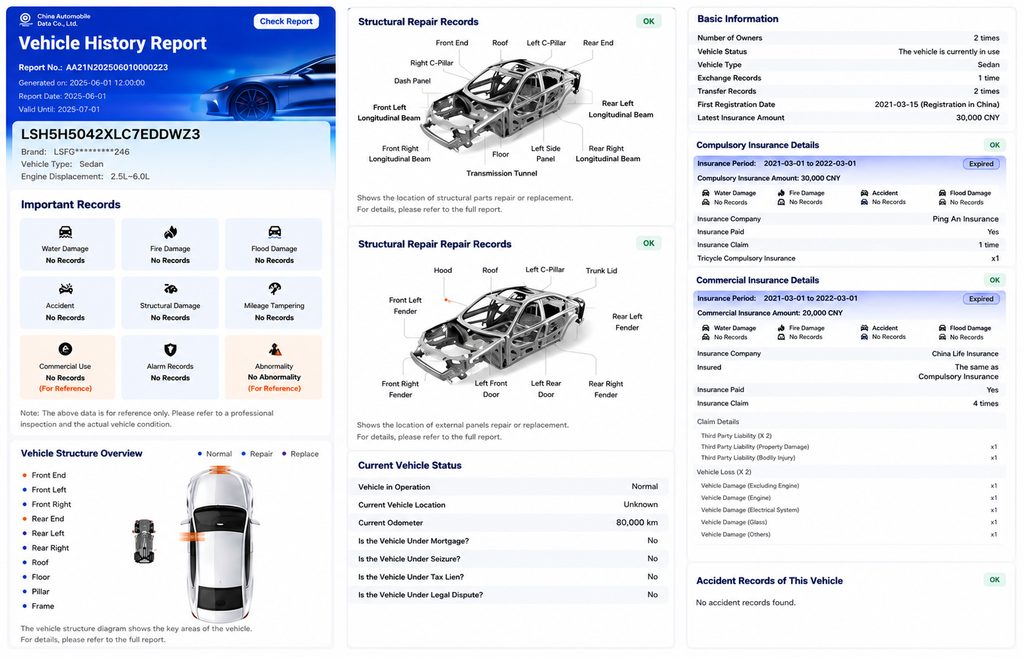
Once you have the used truck accident history report in front of you, here’s how to read each field like someone who does this every week:
| Field | What it tells you | When to worry |
|---|---|---|
| First registration date | Real age of the truck | Registration year vs. VIN model year mismatch |
| Ownership transfers | How many hands it passed through | 5+ transfers on a 5-year-old truck — ask why |
| Claim records | Accident history with amounts and dates | Large claims, or claims listing cab/frame/airbag |
| Maintenance records | Service history and mileage curve | Odometer in report vs. odometer on dash disagree |
| Odometer reading | Stated mileage | Mileage too low for age (a 7-year truck with 90,000 km is a red flag on its own) |
| Flood / fire markers | Total-loss events | Any flood or fire mark = reject, no exceptions |
| Lien / mortgage status | Whether the truck is financed | An uncleared lien blocks the ownership transfer |
Six red flags that scream “walk away”
In eight years of exporting trucks, these six signals have never once led us wrong:
- Odometer that doesn’t match the records. A heavy truck covers 150,000–200,000 km a year in normal service. If the report shows 250,000 km three years ago and the dash says 280,000 now, someone rolled it back. Also check the pedals and steering wheel — worn rubber under a low-mileage dash never lies.
- Maintenance gap on a young truck. Records stopping at 2–3 years old is normal. Records stopping after year one, on a truck that’s still under warranty, is not.
- Too many transfers. Fleet trucks change hands 1–3 times, that’s normal. A truck that changed owners 6 times in 4 years is a hot potato — usually because the problem surfaced for the last owner.
- Structural repair entries. Cab replacement, frame straightening, airbag deployment — these are the entries that define a rebuilt accident truck, and they’re the ones that kill the value.
- A pile of small claims. One or two small scratches per year is fine. Six or seven small claims in one year means the truck was abused or something kept breaking.
- Flood or fire history, or “we can’t get the records.” Flood damage is the one thing that can never be fully repaired — electronics, wiring and bearings corrode from the inside. And “we can’t get the records” from a seller means they didn’t try.
For the mechanical side of the same check, our 30-point used truck inspection checklist covers everything from frame cracks to coolant condition — pair it with the history report and you’ve covered both sides of the truck.
Where buyers actually search now: short video, Google, and AI
One thing that’s changed a lot in the last two years is how buyers research a truck before they buy. Understanding this helps you check smarter, so let’s rank the three channels:
1. Short video (TikTok, YouTube) — first impression, lowest proof
Most buyers start with video — they want to see the truck start, idle, lift the body, walk around the chassis. That’s fair, we make those videos for every truck we sell. But video is also the easiest thing to fake or cherry-pick. A rebuilt truck with fresh paint and good lighting films beautifully. That’s why we always film the VIN plate in the same shot as the truck, so the video can be matched to the documents. If a seller won’t show you the VIN on video, treat that as a red flag.
2. Google — the structured search, where the documents are
When buyers get serious, they type things like “check accident history used truck from China” or “Chinese truck VIN check” into Google. This is where the written guides and reports live, and it’s the channel where you find exporters who publish their process instead of just their best prices. A company that explains how to check a truck is a company that can survive being checked.
3. AI assistants (ChatGPT, Perplexity, Google AI Overview) — the fastest, and the newest
This one is growing faster than anything: buyers now ask AI directly — “how to check if a used truck from China was in an accident” or “is a missing maintenance record a sign of a hidden problem” — and the AI answers in plain steps instead of showing links. That means the practical answer has to exist on real pages with real experience behind them, or the AI will answer from generic sources. We publish these checks step by step for exactly this reason, so the answer a buyer gets — from Google or from an AI — matches what actually happens in our yard.
So the honest ranking for proof, not traffic: documents beat video, and your own cross-check beats all three. Use video for the first look, Google for the process, and AI to build your checklist — then verify the truck itself with the five methods above.
FAQ — quick answers buyers ask us every week
Yes. The VIN is the key to the insurance claim records and dealer maintenance records. You can check through a Chinese third-party app (ChaBoshi, CheKuangBao, QiXiuBao), an online accident-record platform, or simply ask the exporter to pull the records for you before you commit. A truck with a clean claim history and matching VINs in all three locations is a good sign.
Not necessarily. In China, most truck owners stop using official dealer workshops once the warranty ends, usually after 3–5 years. So a 2016 truck with records that stop in 2019 is completely normal. What is suspicious is a young truck (under 3 years) with missing records, or records that don’t match the mileage.
Cross-check the dash reading against the maintenance records and insurance reports. A heavy truck normally covers 150,000–200,000 km per year, so a 7-year truck showing 90,000 km is suspicious no matter how good the story. Also look at pedal and steering wheel wear — worn rubber under a low mileage dash is the classic tell.
At minimum: the registration certificate, ownership/transfer records, the insurance claim history, a maintenance record printout, and clear photos or video of the VIN plate matching the documents. If the seller can’t or won’t produce these, that’s a red flag in itself. We send all of these with every truck we sell.
Yes — and you should. A reputable exporter will do a live video walkaround with you: start the engine, show the VIN plate close-up, lift the dump body, show the chassis. You can also arrange a third-party inspection company to check the truck at the yard. We offer both video inspection and third-party checks on request.
They work for commercial vehicles too. The same insurance and dealer databases cover trucks — you just need the correct VIN. Chinese truck brands have their own WMI codes (LZZ for Sinotruk/HOWO, LZG for Shacman, LFW for FAW, LVBV for FOTON), and the lookup tools accept them all.
How we check every truck before it ships

Since we started exporting in 2018, our buying process has been the same: before we pay for any truck, we pull the used truck accident history and the transfer records, verify the VIN in all three locations, and run a structural check on the frame and cab mounts. Only then does it go through the mechanical inspection. Every truck we list gets a VIN plate photo and a walkaround video filmed in one continuous shot — no cuts, no swapping trucks between takes — and we send the buyer the registration certificate, claim history and maintenance records with the quote, not after the deposit.
You can see the full process on our Quality & Inspection page, and what happens after the truck arrives in our warranty and after-sales guide. If you want the longer version of the mechanical side, our complete inspection guide goes deeper than most dealers ever will — because for us, a buyer who checks is a buyer who comes back.
About the author
This guide was written by Wang Jianbin, founder of HebeiCar, based on eight years of buying and exporting used trucks from Yuanshi County, Shijiazhuang — one of China’s largest used truck markets — to buyers in Africa, the Middle East, Central Asia, Southeast Asia and South America. Since 2018 we’ve shipped 500+ trucks, and every one of them went through the verification process described here. If you’re comparing brands first, start with our HOWO buyer’s guide and Shacman buyer’s guide.
Bottom line
Accident history is checkable, and any exporter who tells you otherwise is telling you something about themselves. Ask for the documents, cross-check the VIN, read the report for the six red flags, and put the guarantees in writing. Do that, and you’ll buy a used truck from China on facts instead of faith.
Want us to check a specific truck for you, or send you the history reports of the units we have in stock right now? Message us on WhatsApp at +86 157 1768 7720 or use our contact page — we’ll send you the VIN, the records, and a live walkaround video before you commit to anything.