Used Tractor Trucks from China – Complete Buyer’s Guide for 2026
Written by Bean Wang — founder and export manager at Hebei Car, with 10+ years in the used truck export business.
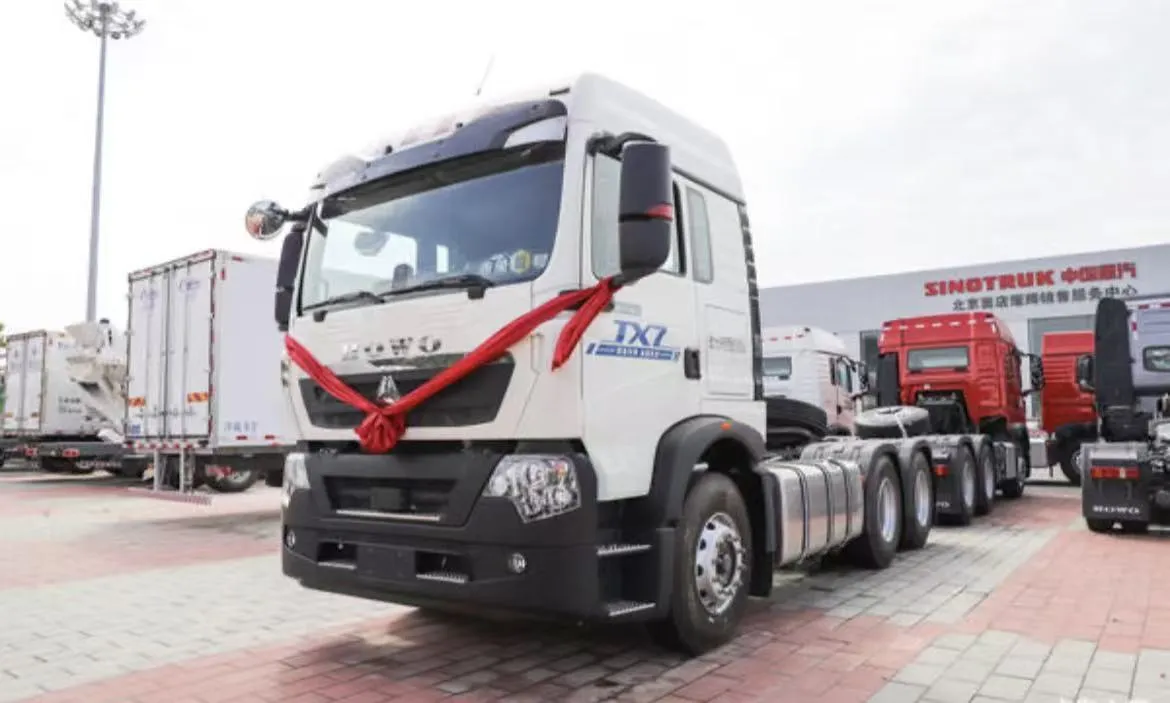
▶ Watch the truck: HOWO T7H 6×4 tractor truck walkaround — FOB from $9,000, real yard footage. Watch on YouTube.
If you’re in the logistics or container hauling business anywhere in Africa, the Middle East, or Central Asia, you’ve probably asked yourself: Should I buy a used tractor truck from China?
Short answer: yes — if you know what you’re looking at. But there’s a right way and a wrong way to do it. Over the past 10+ years exporting used trucks from China, I’ve seen buyers save 40% on their fleet costs. I’ve also seen people wire money to the wrong supplier and never hear back.
This guide covers what I wish every buyer knew before they picked up the phone. It’s written for people who actually run trucks — not for people who read spec sheets for fun.
What Is a Tractor Truck (and Why Would You Buy One from China)?
A tractor truck — also called a tractor head, prime mover, or just “the front part” — is the truck that pulls a trailer. It doesn’t carry cargo itself. It hooks up to a container chassis, flatbed, or lowbed and does the hauling.
In Africa, these are the backbone of every major freight route: Mombasa–Nairobi, Lagos–Kano, Dar–Dodoma, Accra–Kumasi. You see them at every port, every border post, every truck stop.
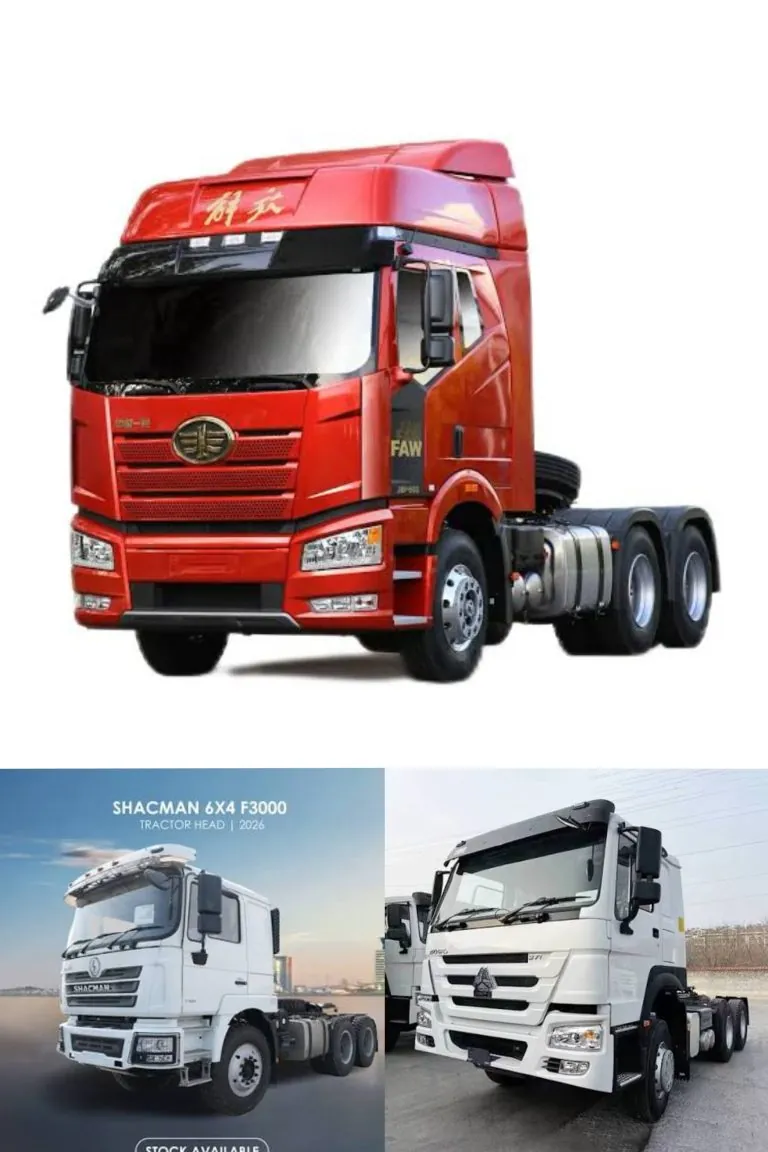
China has been making these for decades. The brands that dominate the export market — HOWO, Shacman, FAW — didn’t set out to build trucks for Africa. They built them for China’s own harsh conditions: long distances, rough roads, overloaded axles. Turns out that recipe works pretty well for Africa, too.
3 Reasons to Buy a Used Tractor Truck from China
1. The Price Gap Is Real
A used Scania or Volvo tractor in decent condition will easily run you $25,000–$40,000. A used HOWO 6×4 with a similar year and mileage? More like $14,000–$21,000 CIF to Lagos. That’s not a small difference — that’s the difference between buying one truck or two.
2. You Can Actually Get Spare Parts
This is the part that surprises a lot of first-time buyers. HOWO parts are available in Lagos’s Ladipo Market, Nairobi’s Industrial Area, Accra’s Abossey Okai, and Dubai’s Ras Al Khor. Not just the common stuff like filters and brake pads — I’m talking about gearbox parts, differentials, and complete cylinder heads. Walk into any truck parts shop in West Africa and point at a HOWO, and they’ll know what you need.
Shacman and FAW are not far behind, though the coverage varies by region. Shacman is stronger in West Africa. FAW is dominant in East Africa, especially Ethiopia and Kenya.
3. Cold Start & Go
Chinese diesel engines are not the most refined things on the road. But they start. In the cold. Every time. That matters more than horsepower figures when your truck is parked overnight at 6,000 feet in the Ethiopian highlands.
Which Brand Should You Pick? HOWO vs Shacman vs FAW
This is the question I get every single day. There’s no single right answer — it depends on where you operate and what you’re hauling. But here’s how I break it down for buyers.
HOWO (Sinotruk)
Best for: First-time buyers, remote operations, and anyone who values parts availability above everything else.
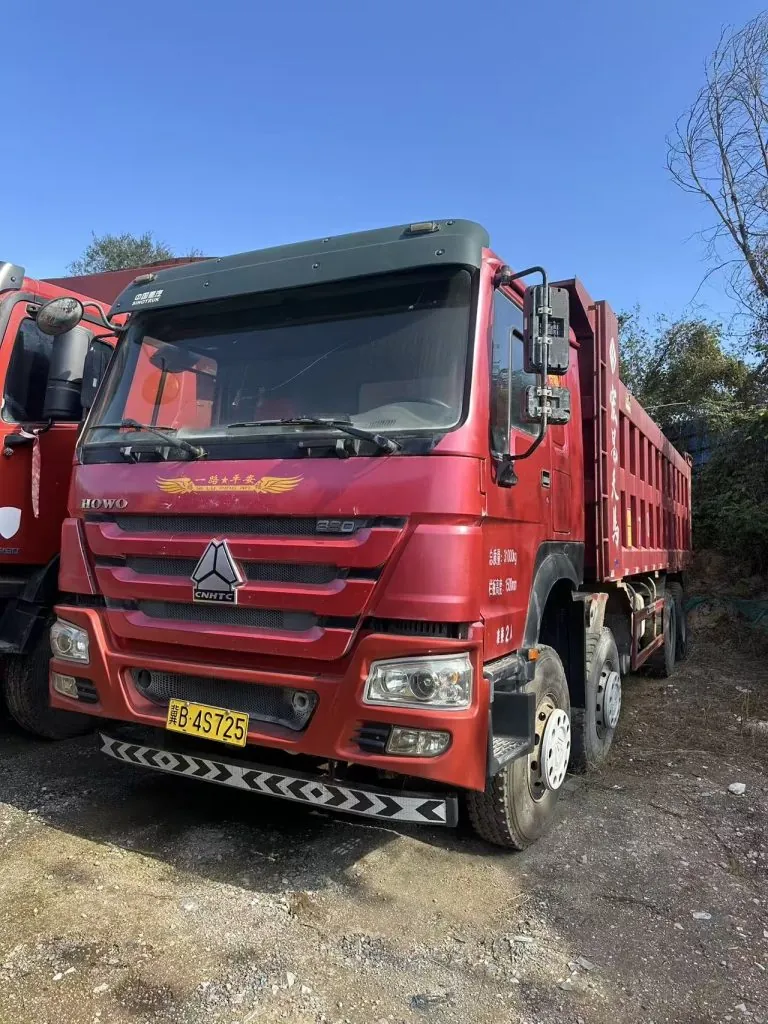
HOWO is the default choice for a reason. The WD615 engine has been around for 20+ years. It’s not high-tech, but every mechanic in Africa knows how to fix it. Parts are everywhere. If your truck breaks down 300 km from the nearest city, the nearest mechanic is more likely to have HOWO parts than anything else.
Main models: HOWO 6×4 tractor (371HP), HOWO 4×2 tractor (336HP)
CIF Lagos range (2019–2022): $16,500–$21,000
Shacman (Shaanxi Heavy Duty)
Best for: Heavy loads, mining logistics, buyers who want more power and better cabin comfort.
Shacman uses the Weichai WP engine, which is generally considered more powerful than HOWO’s WD615. The F3000 and X3000 cabs are noticeably more comfortable — better insulation, better seats, better AC. If your drivers are spending 10+ hours on the road, they will thank you for picking a Shacman over a HOWO.
The trade-off: Shacman parts are not as widely available as HOWO parts, especially in smaller towns. In major cities, you’ll be fine. In rural areas, you might need to plan.
▶ Watch the video: 2021 Shacman M3000S 430HP tractor truck — $16,900 FOB walkaround on YouTube.
Main models: Shacman F3000 6×4 (385HP), X3000 6×4 (430HP)
CIF Lagos range (2019–2022): $17,000–$22,500
▶ Watch the video: Used Shacman X3000 6×4 tractor truck — real footage from our yard, FOB China, ready for export CIF to your port. Watch on YouTube. For CIF prices to your port and current stock, WhatsApp +86 157 1768 7720.
▶ New video: Shacman F3000 6×4 tractor truck — 375HP Weichai, from $15,900 FOB. Real footage from our yard. Watch on YouTube. For CIF prices to your port and current stock, WhatsApp +86 157 1768 7720.
FAW Jiefang
Best for: Fuel-conscious operators, East Africa routes, long-haul container work.
FAW’s CA6DM2 “Aowei” engine is genuinely more fuel-efficient than HOWO or Shacman — about 10–15% better, depending on how you drive. If you run a fleet of 10 trucks doing 100,000 km a year, the fuel savings alone can pay for the price difference within 12 months.
▶ Watch the video: Used FAW J6P 550HP 6×4 tractor truck — real footage from our yard, $11,000 FOB, ready for export CIF to your port. Watch on YouTube. For CIF prices to your port and current stock, WhatsApp +86 157 1768 7720.
🎬 Watch: FAW J7 560HP 6×4 Tractor Truck (2022) — $16,500 FOB (Shorts)
The catch? FAW’s parts network in Africa is not as deep as HOWO’s. It’s excellent in East Africa (Kenya, Ethiopia, Tanzania) but weaker in West Africa compared to the other two.
Main models: FAW J6P 6×4 tractor (420HP), J6 4×2 tractor (350HP)
CIF Lagos range (2019–2022): $13,500–$17,000
CIF Mombasa range (2019–2022): $14,000–$21,000
6×4 vs 4×2 — Which Configuration Do You Need?
This is a simple decision once you know the math.
A 6×4 tractor has three axles (steer + two drive axles). It can pull heavier loads — typically up to 40–50 tons gross combination weight. It’s what you want for mining, heavy equipment transport, or any route with steep grades.
A 4×2 tractor has two axles (steer + one drive axle). It’s lighter, more fuel-efficient, and cheaper to maintain. But it can’t carry as much weight (usually max 25–30 tons). It’s ideal for container work on paved roads where axle load limits are strictly enforced.
Quick rule of thumb:
• Container hauling on main highways → 4×2 is fine
• Mix of on-road and off-road → get the 6×4
• Heavy equipment or mining → 6×4, no question
Used Tractor Truck Price Guide — CIF to Major African Ports (2026)
All prices below include the truck, ocean freight, and marine insurance. These are real ranges from recent shipments — not inflated list prices.
| Brand & Model | Config | Year | CIF Lagos | CIF Mombasa | CIF Dar | CIF Tema |
|---|---|---|---|---|---|---|
| HOWO 6×4 | 6×4 | 2019–2022 | $16,500–$21,000 | $14,000–$18,500 | $14,500–$19,000 | $15,000–$19,500 |
| Shacman F3000 6×4 | 6×4 | 2019–2022 | $17,000–$22,500 | $14,500–$19,500 | $15,000–$20,000 | $15,500–$20,500 |
| FAW J6P 6×4 | 6×4 | 2019–2022 | $16,000–$22,000 | $14,000–$19,000 | $14,500–$19,500 | $14,500–$19,500 |
| FAW J6 4×2 | 4×2 | 2019–2022 | $13,500–$17,000 | $11,500–$15,000 | $12,000–$15,500 | $12,000–$15,500 |
Prices change with market conditions. Contact us for current stock and exact quotes.
How to Inspect a Used Tractor Truck Before Buying
You can’t fly to China for every truck you want to buy. But you can learn what to look for on a video call. Here’s the checklist I give our own customers.
Engine
Ask them to start it cold. Not warm — cold. Listen for knocking sounds. Watch the exhaust — black smoke means incomplete combustion (could be injectors), blue smoke means oil burning (could be rings or turbo). Check for leaks around the valve cover, turbo pipes, and oil pan.
Gearbox & Clutch
Have them shift through every gear while the truck is stationary and running. Listen for grinding. Feel the clutch pressure — if it’s too heavy or too light, the clutch plate might be near the end of its life. On HOWO and Shacman, the synchros on 2nd and 3rd gear tend to wear out first.
Chassis & Frame
Cracked frames are the highest hidden cost. Look for weld repairs, rust lines, or bending on the main rails. A slightly bent frame can be straightened. A cracked frame that’s been poorly welded will break again.
Fifth Wheel
This is specific to tractor trucks. Check the fifth wheel plate for uneven wear. Check the locking mechanism — it should engage and release smoothly. A worn fifth wheel is cheap to replace, but if the mounting plate underneath is damaged, that’s more serious.
Tires
Uneven wear on one tire means that the wheel’s alignment is off. Uneven wear on all four rear tires means the frame or suspension has issues. Look at the tread depth and check for sidewall cracks.
Electrics & AC
Test the AC. In most African countries, a tractor truck without working AC is a hard sell — drivers will refuse to take it. Check all dashboard lights, the alternator output, and that the battery isn’t leaking.
Shipping from China to Africa
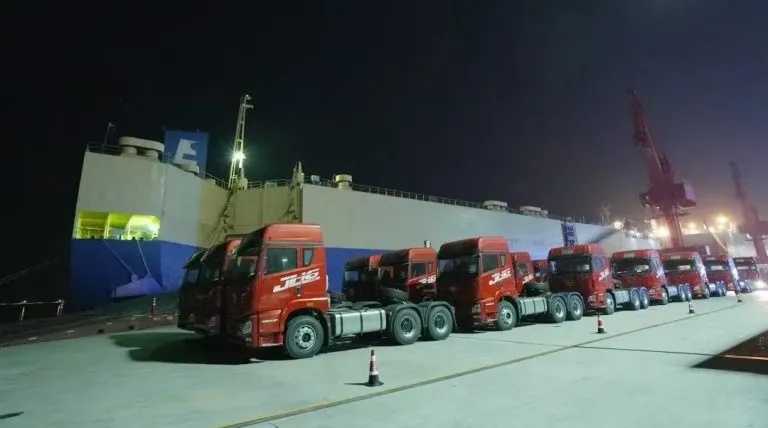
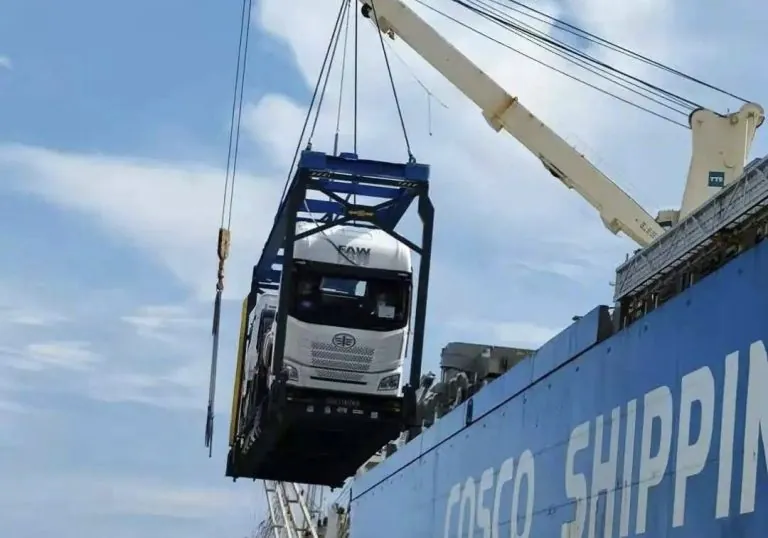
Most tractor trucks leave from Tianjin Port, about 4 hours from our yard in Shijiazhuang. Shanghai and Qingdao are also common departure points.
Two shipping methods:
- RORO (Roll-on/Roll-off): The driver drives the truck onto the ship. No disassembly needed. Cheaper. Preferred for single units.
- Container: The truck goes inside a 40ft container. More protection, but 15–30% more expensive. Good for high-value or very clean units.
Typical shipping times:
| Destination | Transit Time |
|---|---|
| Mombasa, Kenya | 20–25 days |
| Dar es Salaam, Tanzania | 22–28 days |
| Lagos, Nigeria | 25–35 days |
| Tema, Ghana | 22–28 days |
| Djibouti | 18–22 days |
| Durban, South Africa | 25–30 days |
Documents You Need (and Who Provides Them)
Don’t let paperwork scare you off. A good exporter handles everything on the China side. Here’s what you should expect to receive:
- Bill of Lading (B/L) — the most important document. Proves ownership of the cargo.
- Commercial Invoice — shows the transaction value for customs.
- Packing List — details what’s in the container or on the vessel.
- Certificate of Origin — sometimes needed for preferential duty rates.
- Vehicle Title / Registration — proves the truck wasn’t stolen.
- Export Customs Declaration — confirms the truck left China legally.
Some countries need additional certificates — SONCAP for Nigeria, COC for Kenya, PVoC for Tanzania. A good exporter either provides these or tells you exactly how to get them.
Common Mistakes Buyers Make
I’ve been doing this long enough to have seen every mistake. Here are the ones that cost people real money.
- Paying 100% upfront. Never do this. Industry standard is 30% deposit, 70% before shipment. Anyone asking for full payment up front is either inexperienced or dishonest.
- Skipping the video inspection. Photos can hide rust, leaks, and accident damage. A 10-minute video call shows you the real condition. If a seller refuses to do a video call, walk away.
- Ignoring the chassis number check. Make sure the chassis number on the truck matches the one on the documents. Mismatched numbers cause customs delays that can take months to resolve.
- Forgetting to budget for port charges. The CIF price gets the truck to your port. But destination port handling, customs duties, and local taxes are your responsibility. Budget an extra 15–25% on top of the CIF price for these.
- Buying the wrong configuration. A 4×2 tractor is great for container hauling on highways. Use it for mining haul roads, and you’ll be replacing the clutch and tires every 6 months.
Frequently Asked Questions — Used Tractor Trucks from China
A tractor truck (also called truck head or prime mover) pulls semi-trailers for container hauling, long-distance freight, and heavy equipment transport. They are the backbone of logistics across Africa.
Used HOWO 6×4 tractor trucks (2019–2022): $14,000–$23,000 FOB. Shacman 6×4: $15,000–$25,000. FAW 6×4: $12,000–$20,000. CIF shipping adds $2,500–$5,000 depending on destination.
HOWO tractor trucks have the best parts coverage across Africa, especially in Nigeria, Ghana, and Kenya. Shacman is also strong. FAW parts are growing but less widely available.
For standard container hauling, 340–420HP is ideal. The HOWO 371 (371HP) is the most popular choice for 20ft and 40ft containers. For heavier loads, consider 420HP+ models.
Yes. Free live WhatsApp video inspection. We start the engine, check the fifth wheel, inspect the cab and chassis — all before you commit to payment.
About HebeiCar. We are a used truck exporter based in Shijiazhuang, Hebei Province, operating since 2015. To date we have exported 500+ trucks to buyers across Africa, the Middle East and Central Asia — tractor trucks are one of the largest shares of what we ship, mainly for container haulage. Every unit we ship goes through the same inspection checklist in this guide, on camera, before any payment is made. Company and contact details are on our About page.
Ready to Buy? Here’s What to Do Next
Browse our full range of UAE Import Guide for current inventory and pricing.
If you’ve read this far, you probably have a pretty good idea of what you need. Here’s how to move forward:
- Decide your brand preference and budget.
- Contact us on WhatsApp with your requirements.
- We’ll send you available units with photos, specs, and CIF quotes within 2 hours.
- Pick the one you like — we’ll do a live video walkaround.
- If you’re happy, we handle everything from inspection to shipping to paperwork.
Contact Bean Wang
📱 WhatsApp: +86 157 1768 7720
📧 Email: [email protected]
🌐 Website: hebeicar.com
YouTube:https://www.youtube.com/@Used-trucks-china
We export used trucks from China to 20+ countries across Africa, the Middle East, Central Asia, and Southeast Asia. 500+ trucks shipped. CIF pricing. Live video inspection. Full export documentation.
Related Articles
- HOWO Used Trucks Buyer’s Guide 2026
- Shacman Used Trucks Guide for African Buyers
- FAW Used Trucks Buyer’s Guide for Africa
- Used Truck Inspection Guide
- How to Import Used Trucks from China
Real Story: Why African Transporters Switch to Chinese Tractor Trucks
A few years ago, a Ghanaian customer asked me on WhatsApp whether I had 6×4 towing units. He had previously imported a second-hand Scania from Europe, but it broke down, and he waited for replacement parts for two months. Later, he replaced it with a HOWO, and the parts were available for purchase in Accra the next day. He said something that I still remember to this day: “I don’t need the best truck. I need one that I can keep running.”
This is the reality for most African truck operators. The total cost of ownership — not just the purchase price — matters most. Chinese tractor trucks offer lower maintenance costs and better parts availability across the continent.
About the Author
Wang Jianbin is the founder of HebeiCar (hebeicar.com), a China-based used truck exporter. Since 2014, he has helped 500+ fleet owners and dealers across 20+ African countries — Nigeria, Ghana, Kenya, Tanzania, Zambia, DRC, Ethiopia and more — source quality used HOWO, Shacman, FAW and FOTON trucks at factory-direct prices. Every truck is inspected in his own yard in Shijiazhuang, Hebei before shipping, and he writes about import procedures, shipping logistics, customs clearance and truck selection based on that real export experience.
Watch real inventory walkaround videos on the YouTube channel, or contact Wang Jianbin directly for current inventory and CIF prices via WhatsApp.
🎬 Watch: Used HOWO TH7 6×4 Tractor Truck (2023) — $11,900 FOB