How to Find a Reliable Used Truck Supplier in China: 2026 Complete Guide for African Buyers
This guide is based on our team’s 10+ years of experience exporting used trucks from Shijiazhuang, China. While we use AI tools to help structure our content, every tip and figure included has been manually verified by our export team.
Every week, we hear from buyers in Nigeria, Ghana, Kenya, Tanzania, and Zambia who have lost money to dishonest Chinese used truck sellers. A $5,000 deposit sent to a supplier who then disappears. A truck that arrives at port with a different engine than the one shown in the video. A seller who claims a 2018 model that turns out to be a 2014.
The problem is not that Chinese trucks are used — the product is excellent value. The problem is finding the right supplier. China’s used truck export industry is largely unregulated, and anyone with a smartphone and a yard of used trucks can call themselves an exporter. Separating reliable exporters from middlemen and scammers is the single most important skill for any African buyer. This checklist shows exactly how we vet a used truck supplier in China before any deposit leaves your bank account.
This guide teaches you exactly how to find, verify, and work with a trustworthy Chinese used truck supplier — with real examples, specific checks, and practical tips. Understanding the Chinese Used Truck Export Market
1. Understanding the Chinese Used Truck Export Market
1.1 Who Sells Used Trucks in China?
There are four types of sellers in the Chinese used truck export market. Understanding the difference is critical.
| Seller Type | Description | Reliability | Price Level | Best For |
| Direct Exporter | A company with an export license owns truck stock and handles all documentation. | ★★★★★ | Competitive | First-time and experienced buyers |
| Factory Outlet | Authorized dealer of truck brand (HOWO, Shacman), selling trade-in or surplus stock | ★★★★★ | Higher | Buyers want the best-condition trucks |
| Agent / Broker | A middleman who connects buyers with stock yards does not own trucks | ★★★☆☆ | 10–20% markup | Buyers who already know the agent personally |
| Online Scammer | Fake accounts on WhatsApp, Facebook, Alibaba — no real trucks, only stolen photos | ★☆☆☆☆ | Suspiciously low | Nobody |
Key insight: A direct exporter who owns their own stock is almost always preferable. They control the quality, handle the paperwork, and are accountable for what they sell.
1.2 Typical Price Markup Chain
When you buy from a middleman, here is how the price gets inflated:
Truck Source (stock yard)
↓
Middleman / Agent (adds 10-20%)
↓
You, the buyer
Real example: A 2019 HOWO 6×4 dump truck might be sourced from a stock yard at $13,000. A direct exporter sells it to you at $14,500 (fair margin). An agent sells the same truck at $17,000—$18,000 without adding any real value.
1.3 Geography: Where Are the Trucks Located?
Used truck export hubs in China:
| City | Province | Main Brands | Notes |
| Shijiazhuang | Hebei | All brands | There is the largest second-hand truck market in North China. |
| Jinan | Shandong | HOWO (Sinotruk) | Factory city, many direct sellers |
| Xi’an | Shaanxi | Shacman (Shaanxi) | Factory city for Shacman |
| Shanghai | Shanghai | All brands, especially for export | Major port, higher prices |
| Guangzhou | Guangdong | Dongfeng, Foton | Southern hub, good for SEA shipping |
| Tianjin | Tianjin | All brands | Major port, competitive prices |
Step 1: Finding Potential Suppliers
2.1 Best Channels to Find Suppliers
Channel A: Direct Contact (Best)
Search on Google for “used truck exporter China” or “Chinese used truck supplier” and visit their websites directly. A legitimate exporter will have:
- ✅ A professional website with real inventory listings
- ✅ Company address and phone number you can verify
- ✅ Photos and videos of actual trucks in their yard
- ✅ Clear pricing or willingness to quote
- ✅ Business registration information
Example of a good supplier website: A website like hebeicar.com that shows specific trucks with photos, has a physical address in Shijiazhuang, provides contact information, and clearly describes their services.
Channel B: Alibaba / Made-in-China.com (Mixed)
These B2B platforms have both legitimate exporters and scammers. If using these:
- Check the supplier’s verified status (Gold Supplier, Assessed Supplier)
- Look at how long they have been on the platform (2+ years is better)
- Read reviews and transaction history
- Request their company registration number and verify it
- Ask if they have a physical yard you can visit (or get a video walkthrough)
Channel C: WhatsApp / Facebook (Danger Zone)
This is where most scams originate. Be extremely cautious with suppliers found through:
- Cold WhatsApp messages offering “best prices.”
- Facebook groups where users post truck photos without company names
- Telegram channels advertising unrealistically cheap trucks
- Instagram accounts with only a few posts
If a supplier contacts YOU first with a great deal, it is almost always a scam.
2.2 Red Flags in Initial Contact
| Red Flag | Why It’s Dangerous |
|---|---|
| Supplier’s photos look professional, but no company logo | The truck doesn’t exist, or has hidden damage |
| Supplier only communicates via WhatsApp, no website or email | No accountability, easy to disappear |
| The supplier asks for full payment up front | You lose everything if they vanish |
| Supplier claims to be in “all brands” with “unlimited stock.” | Photos are stolen from another website |
| The supplier can’t or won’t do a live video call | Middleman with no real inventory |
| The supplier is in a different city than where the trucks are located | The trucks may not exist |
| Payment requested to a personal bank account (not a company account) | They are a broker, not the owner |
| The supplier is in a different city from where the trucks are located | Price is 30-50% below the market average |
Step 2: How a Chinese Supplier Is Verified: The 10-Point Checklist
Before sending any money, complete this checklist. A legitimate supplier will pass every check.
Check 1: Business Registration
Every legitimate business in China must have a Business License issued by the State Administration for Market Regulation (SAMR).
What to ask for:
- Request a clear photo of the supplier’s Business License
- Check the following fields:
- Company Name — does it match the name they use?
- Registered Address — is it a real location, not a residential apartment?
- Business Scope — does it include “import and export of automobiles”?
- Registration Date — how long has the company existed?
- Registered Capital — higher is generally better (>1 million RMB is good)
How to verify online:
Go to the Chinese government’s National Enterprise Credit Information Publicity System at http://www.gsxt.gov.cn and search for the company name. Alternatively, ask the supplier to share their credit report from Qichacha or Tianyancha.
⚠️ Critical warning: Scammers can create fake Business Licenses using Photoshop. If the license looks suspicious (wrong font, odd formatting, unusual registration number format), ask for a video verification or check with the local SAMR office.
Check 2: Physical Address Verification
A legitimate truck exporter has a physical yard where trucks are stored. Use Google Maps or Baidu Maps to verify.
What to check:
- Search the address on Google Maps / Baidu Maps
- Does the satellite view show a truck yard?
- Does the street view match what the supplier shows in photos?
- Is it an industrial area (good) or a residential building (suspicious)?
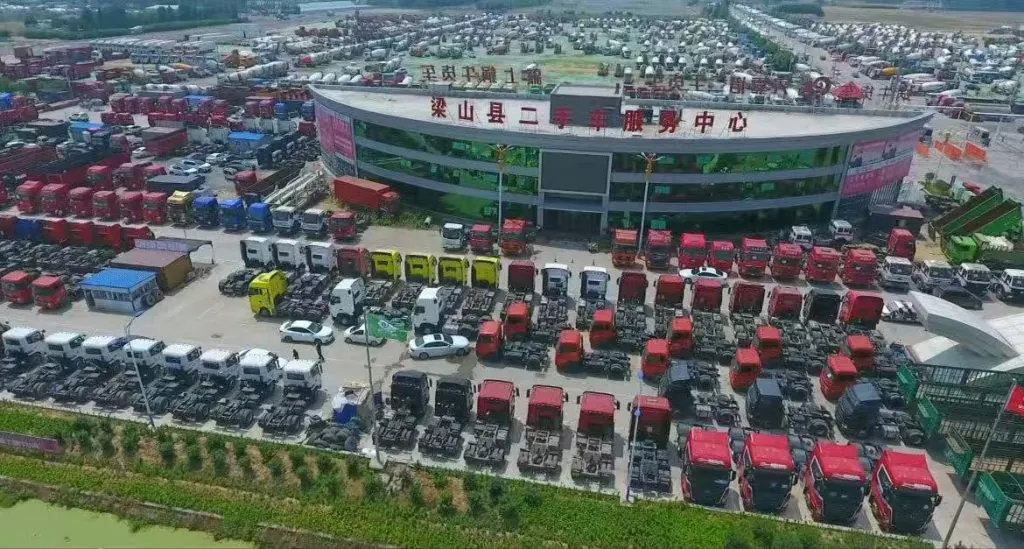
Example: In Shijiazhuang, the second-hand truck market is located in Yuanshi County, Shijiazhuang. In satellite images, their storage area will show rows of trucks.
Check 3: Real-Time Video Verification
This is the single most important check. Insist on a live video call.
What to ask for during the video call:
- Walk around the truck yard — show 5-10 random trucks visible in the background
- Zoom in on a truck’s VIN plate
- Show the engine bay of the truck you are interested in
- Start the engine (from cold) and let you hear it run
- Show the company sign/logo on the building
- Show the office area with staff working (if applicable)
If the supplier refuses a live video call, do not do business with them. Period.
Check 4: Export History
Ask the supplier for evidence of past exports to your country or region.
What to ask for:
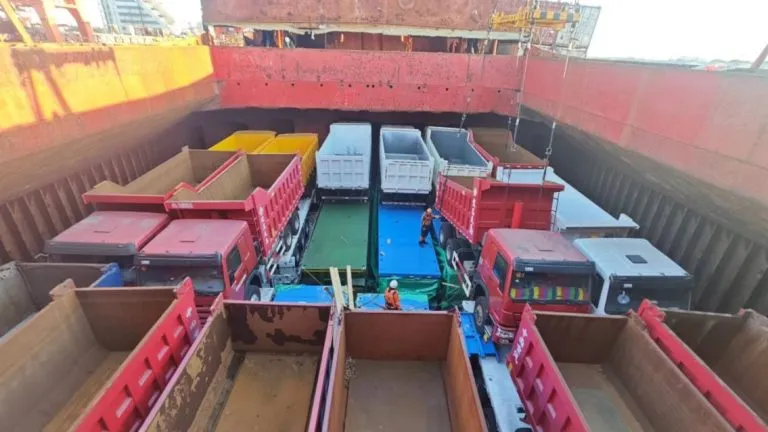
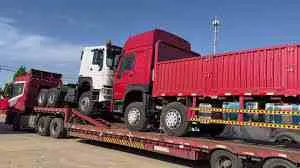
- Photos of trucks loaded in containers or on RoRo ships
- Past Bills of Lading (with buyer details redacted for privacy)
Check 5: Payment Terms Assessment
Standard payment terms for legitimate used truck exports from China:
| Payment Term | Standard | Risky |
|---|---|---|
| Deposit | T/T to the company bank account | Over 50% deposit |
| Balance payment | Before shipping, after inspection | Full payment before inspection |
| Payment method | Written contract with both parties’ signatures | Cash, crypto, personal account, third-party |
| Contract | Written contract with both party signatures | 20-30% of the total |
Safe payment process:
- Sign contract → pay 30% deposit
- Supplier prepares the truck / conducts any agreed repairs
- You (or your third-party inspector) inspect the truck
- If satisfied → pay the remaining 70%
- Supplier ships the truck and provides the Bill of Lading
Check 6: Communication Quality
The quality of communication tells you a lot about the supplier.
| Good Sign | Bad Sign |
|---|---|
| Responds within 24 hours | Takes days to reply, or messages feel automated |
| Answers your specific questions directly | Gives vague answers, avoids details |
| Claims every truck is “perfect, no problems.” | Pushes you to “hurry up and pay.” |
| Speaks English adequately or has an interpreter | Communication is very difficult |
| Patient with your questions | Says, “Don’t worry, I handle everything.” |
| Explains the process clearly | Says, “Don’t worry, I handle everything” |
Check 7: Contract Review
A legitimate exporter provides a written contract in both Chinese and English. Before signing:
What should be in the contract:
- [ ] Truck identification: Chassis number (VIN), year of manufacture, make, model, color
- [ ] Purchase price in USD
- [ ] Incoterms: FOB, CIF, or CNF clearly stated
- [ ] Payment schedule and payment method
- [ ] Delivery timeline (when the truck will be ready and shipped)
- [ ] Warranty terms (if any — most used trucks have a limited warranty)
- [ ] Inspection rights (buyer’s right to inspect before final payment)
- [ ] Dispute resolution clause
- [ ] Signatures and company stamps from both parties
Check 8: Third-Party Inspection
A trustworthy supplier welcomes third-party inspection. A supplier who discourages it has something to hide.
What a third-party inspection covers:
- Vehicle identity verification (VIN, engine number, year of manufacture)
- Visual inspection of the body, chassis, and cabin
- Engine condition check (oil leaks, unusual sounds, compression)
- Transmission and drivetrain
4. Step 3: Remote Truck Inspection — What to Look For
Even with a trustworthy supplier, you need to inspect the specific truck you are buying. Here is how to do it remotely.
4.1 Videos You Must Request
| Dashboard lights (check engine light ON/OFF), odometer reading, seat condition, and steering wheel wear | What to Film | What to Look For |
|---|---|---|
| 1 | Walkaround — front, both sides, rear, roof | Body damage, rust, panel alignment, paint consistency |
| 2 | Cold engine start (engine MUST be cold) | Smoke color at startup (blue = oil burning, white = coolant, black = over-fueling). Listen for knocking sounds. |
| 3 | Engine running (3 minutes) | Oil pressure light goes off, no unusual ticking or knocking, smooth idle |
| 4 | Cabin interior | Undercarriage/chassis |
| 5 | Gear shifting (if the truck is running) | Rust level, frame straightness, leaks (oil, transmission fluid, brake fluid) |
| 6 | Tires — all 6+ tires close up | Tread depth measurement, uneven wear (indicates alignment issues), brand, age |
| 7 | Each gear engages smoothly, with no grinding sounds | Each gear engages smoothly, no grinding sounds |
4.2 Common Problem Areas for Chinese Used Trucks
| Problem Area | How to Check Remotely | Acceptable? |
|---|---|---|
| Engine oil leaks | Ask for photos of the engine block from below | Minor seepage is normal; active dripping is a problem |
| Turbocharger condition | Ask about clutch replacement history. Observe gear engagement difficulty in the video. | Some turbo whistle is normal; a loud whine means replacement is needed |
| Clutch wear | Look for cracked rubber bushes in the walk-around video | If never replaced on a 200k+ km truck, budget for replacement |
| Cab suspension bushes | Rust on the chassis | Worn bushes affect ride quality and cost ~$100–$200 to replace |
| Slow lifting indicates pump wear; leaking cylinders need rebuilding | Check especially near leaf spring mounting points | Surface rust is normal; deep pitting or flaking rust is bad |
| Dump truck hydraulic pump (dump trucks only) | Ask for a video of the hydraulic system — lift the dump body | Listen for the whistling sound in the engine video |
| Electrical system | Check that all lights work in the video, and no warning lights on the dashboard | Check that all lights work in the video, and no warning lights are on the dashboard |
4.3 Document Verification Checklist
Request clear photos of these documents:
| Document | What to Verify |
|---|---|
| Vehicle Registration Certificate | VIN, engine number, year of first registration, vehicle model — all must match the truck |
| VIN Plate (on dashboard or chassis) | VIN must match the registration certificate. Decode the VIN to confirm the year: 10th character = year (J=2018, K=2019, L=2020, M=2021, N=2022) |
| Engine Nameplate | Engine model number must match registration. Check the engine manufacturing date. |
5. Step 4: Making a Safe Payment
5.1 Payment Methods Compared
| Method | Safety | Speed | Cost | Notes |
|---|---|---|---|---|
| T/T to Company Bank Account | ★★★★★ | 2–5 days | $30–$50 fee | Best option — traceable, verifiable, legal |
| Letter of Credit (L/C) | ★★★★★ | 5–10 days | $200–$500 fee | Best for large orders ($50k+). Bank guarantees payment. |
| T/T to Personal Account | ★☆☆☆☆ | 1–3 days | $20–$30 fee | Avoid — no legal protection, common scam method |
| Western Union / MoneyGram | ★☆☆☆☆ | Instant | High fees | Avoid entirely — irreversible, preferred by scammers |
| Cash | ★★☆☆☆ | Instant | None | Avoid — no paper trail, risky |
| Alibaba Trade Assurance | ★★★★☆ | Varies | Included | Good if using the Alibaba platform. Provides buyer protection. |
5.2 The Standard Payment Process
- Step 1 — Sign purchase contract (both parties sign)
- Step 2 — Pay 30% deposit to the supplier’s company bank account
- Step 3 — Supplier prepares truck, sends you progress updates (photos/videos)
- Step 4 — You inspect the truck (via video or third-party inspection)
- Step 5 — If satisfied, pay the remaining 70%
- Step 6 — Supplier loads and ships the truck, gives you the Bill of Lading
⚠️ Never deviate from this process. If a supplier demands a 50%+ deposit or full payment before you can inspect the truck, consider it a major red flag.
5.3 Bank Transfer Details to Verify
When making a T/T payment, verify:
- ✅ Beneficiary name must match the company name on the Business License
- ✅ Bank account is a corporate account (usually starting with a number, not a personal savings account)
- ✅ SWIFT code matches the bank’s official SWIFT code
- ✅ Bank address is in the same city as the company’s registered address
- ❌ If the bank is in a different city from the company address — suspicious
6. The 5 Most Common Mistakes African Buyers Make.
Mistake 1: Choosing the Cheapest Price
What happens: You choose the supplier with the lowest quote to save $1,000. The truck arrives with hidden problems that cost $3,000–$5,000 to fix.
Lesson: The lowest price is often the most expensive option in the long run. Pay a fair price to a reputable supplier.
Mistake 2: Relying Only on Photos
What happens: The photos show a clean truck with good tires. The actual truck has worn tires, a cracked windshield, and engine leaks — problems that photos can hide.
Lesson: Always request videos and live video calls. Better yet, pay for a third-party inspection.
Mistake 3: Not Verifying the Year of Manufacture
What happens: A supplier advertises a “2018 truck.” It arrives and turns out to be 2014, which is over the 10-year import limit for Ghana, or the 8-year limit for Kenya. You cannot register it.
Lesson: Verify the year from the VIN (10th character), the vehicle registration certificate, and the VIN plate on the truck itself. Cross-check all three.
Mistake 4: Sending Full Payment Upfront
What happens: The supplier disappears with your money.
Lesson: Never pay 100% upfront. The industry standard is 30% deposit / 70% on balance after inspection.
Mistake 5: Not Having a Written Contract
What happens: The supplier delivers a different truck than what you agreed on. You have no legal document to prove what was agreed.
Lesson: Always have a written contract in both Chinese and English, signed and stamped by both parties. It is your only legal protection.
7. Comparison: How Major Chinese Used Truck Exporters Compare
| Factor | HebeiCar.com (Direct Exporter) | Unknown Alibaba Seller | WhatsApp-Only Seller |
|---|---|---|---|
| Located in | Shijiazhuang, Hebei (truck hub) | Unknown | Unknown |
| Owns truck stock | ✅ Yes — real inventory | ❌ Usually no | ❌ No |
| Business License | ✅ Available and verifiable | ❓ Hard to verify | ❌ Not provided |
| RHD trucks | ✅ Yes — factory RHD for Africa | ❓ Sometimes | ❌ No |
| Third-party inspection | ✅ Welcomed and coordinated | ❓ May resist | ❌ Will refuse |
| Live video call | ✅ Yes, anytime | ❓ Maybe, but vague | ❌ Excuses |
| Company bank account | ✅ Yes | ❓ Personal account often | ❌ Definitely personal |
| Export experience | ✅ Proven — trucks to Nigeria, Ghana, Kenya, Tanzania, Zambia, UAE | ❓ Unknown | ❌ None |
| Customer references | ✅ Available | ❓ Not available | ❌ Not available |
Summary: Your Supplier Verification Checklist
Before sending any money, check off every item:
1. Initial Assessment
- [ ] Supplier has a professional website with real inventory
- [ ] Supplier is a direct exporter, not a middleman
- [ ] Price is within a reasonable market range
- [ ] Supplier can communicate clearly in English (or has an interpreter)
2. Verification
- [ ] Business License obtained and verified
- [ ] Physical yard address confirmed (Google Maps / Baidu Maps)
- [ ] Live video call conducted — saw the actual yard and trucks
- [ ] Export history references checked
- [ ] Company bank account details verified against Business License
3. Truck-Specific
- [ ] Truck VIN decoded — year confirmed
- [ ] All 7 inspection videos received and reviewed
- [ ] Vehicle registration document photos received and verified
- [ ] Third-party inspection arranged (recommended for first-time buyers)
4. Contract and Payment
- [ ] Written contract with all mandatory clauses signed
- [ ] Payment is to a company bank account (30% deposit / 70% after inspection)
- [ ] Incoterms clearly stated in the contract
- [ ] Delivery timeline agreed in writing
Your partner in China:
🔗 Related Products
- China HOWO heavy truck
- China HOWO heavy truck
- HOWO TH7
- HOWO T7H
- Great Wall Pickup Truck – Windjun 6
- The Great Wall Cannon
About the Author
Wang Jianbin is the founder of HebeiCar (hebeicar.com), a China-based used truck exporter. Since 2014, he has helped 500+ fleet owners and dealers across 20+ African countries — Nigeria, Ghana, Kenya, Tanzania, Zambia, DRC, Ethiopia and more — source quality used HOWO, Shacman, FAW and FOTON trucks at factory-direct prices. Every truck is inspected in his own yard in Shijiazhuang, Hebei before shipping, and he writes about import procedures, shipping logistics, customs clearance and truck selection based on that real export experience.
Watch real inventory walkaround videos on the YouTube channel, or contact Wang Jianbin directly for current inventory and CIF prices via WhatsApp.
Frequently Asked Questions
Ask for their Chinese business license, request a live video walkaround of the actual yard, and check their export history through customs records. A reliable exporter will show you the truck you are buying on video before you pay anything.
A 30% deposit after live video inspection is normal industry practice. Never pay 100% upfront, and never send money to a personal account of someone you have not verified. The balance is paid only after you confirm the truck on video.
Use free WhatsApp video inspection covering engine start, chassis condition, cab interior and tires. For extra confidence, request a third-party inspection report or a paid mechanic check before the balance payment.
A sales contract, export license, customs declaration records, inspection photos and videos, and the bill of lading once shipped. Keep everything in writing so you have proof if a dispute arises.
Related guides
If you are working through the next step of an import, these guides answer the questions buyers ask us most: